
A step-through electric trike uses an open, low-clearance frame that allows riders to get on and off without lifting a leg high over a center tube.
When comparing electric trikes for seniors, many shoppers naturally look first at motor wattage, battery range, or top speed.
Those specifications matter—but the way the frame fits the rider can make just as much difference in everyday comfort. Step-through height, pedal position, back support, riding posture, and smooth electric assistance all influence whether a trike actually feels easy to use.
Quick answer: A low step-through electric trike can make riding easier by reducing how high the rider needs to lift a leg when getting on and off. That can be especially helpful for older adults, returning cyclists, and riders who value easier access or have limited flexibility.
But low entry alone doesn't create a comfortable trike. The best designs combine easier access with a supported riding position, natural pedal placement, smooth motor response, and stable three-wheel geometry.
Why Step-Through Design Matters More Than Many Riders Expect
It is easy to assume that any three-wheel bicycle will automatically be easy to get onto.
In reality, electric trikes use many different frame designs. Some have a relatively high center section, while others create a much more open entry area.
That distinction becomes especially important for riders who find it uncomfortable to lift one leg high, swing it over a frame, and then settle onto the saddle.
Comfort should begin before the wheels start moving. If getting onto the trike already feels difficult, a powerful motor cannot solve the entire problem.
This is one reason frame geometry deserves more attention when comparing electric trikes for seniors.
The rider has to interact with the frame every single time they leave home, stop at a store, take a break, or return to the trike later.
What a Step-Through Frame Helps With — and What It Does Not
A low step-through primarily solves an access problem: it reduces the amount of leg lift needed to enter or exit the trike.
It Can Help With
Mounting, dismounting, repeated stops, getting back on after a break, and reducing awkward leg movement.
It Does Not Automatically Solve
Turning technique, braking, rider fit, cargo balance, or overall stability. Those depend on the complete trike design and how it is ridden.
This distinction matters because a trike can have a very low frame and still feel uncomfortable if the seat, pedals, handlebars, or power delivery do not fit the rider well.
Traditional Trike Design vs Comfort-Focused Electric Trike Design
Not every traditional or entry-level electric trike uses the same components, so it is better to compare actual design characteristics rather than assume that one entire category is built the same way.
| Riding Element | Conventional Trike Design | Comfort-Focused Electric Trike |
|---|---|---|
| Step-through access | Frame height varies and may require more leg lift. | Low, open center frame designed for easier entry. |
| Pedal position | Often positioned more directly beneath the rider. | May move forward to support a more relaxed seated posture. |
| Back support | Varies by model and may be limited. | Adjustable back support can work together with the saddle. |
| Power delivery | Cadence or torque sensing depending on the model. | Smooth torque-sensing assistance can respond more naturally to rider effort. |
| Everyday controls | Features vary widely. | Look for reverse mode, parking brake, hydraulic braking, and a rear differential. |
| Cargo use | Basket size and capacity vary. | Heavy-duty utility designs can support larger everyday loads. |
Ultra-Low Step-Through for Easier Mounting
Every ride begins with getting onto the trike.
For riders with reduced flexibility, limited range of motion, knee discomfort, or concerns about balance, unnecessary leg lifting can make this first step feel more difficult than it needs to be.

E-COZY: 14.8" Ultra-Low Step-Through
E-COZY uses a 14.8-inch ultra-low step-through measured from the ground to the entry area.
The open frame reduces how high the rider needs to lift a leg while getting onto or off the trike.
Instead of:
lift high → balance → sit
the movement becomes closer to:
step through → sit → ride
Why does a lower step-through matter?
- Less unnecessary knee and hip lifting.
- Easier repeated stops during errands.
- A simpler way to position the body on the saddle.
- Less effort when returning to the trike after a break.
- A more approachable start to each ride.
Design idea: A trike chosen for comfort and stability should be easy to approach before the rider even begins pedaling.
Riding Position Matters After You Sit Down
A low frame solves the mounting problem.
But getting onto the trike is only the first part of the riding experience.
After five, ten, or twenty minutes, the relationship between the saddle, pedals, handlebars, hips, knees, and back becomes much more important.

A more supported riding position can matter just as much as the height of the frame.
ComfortFit™ Forward-Pedaling Geometry
Traditional bicycle geometry normally positions the pedals more directly beneath the rider.
That can work very well for conventional bicycle riding, especially when the rider frequently shifts position or uses a more active posture.
E-COZY takes a different approach.
The bottom bracket and pedal position move farther forward, allowing the rider's legs to extend slightly ahead while the upper body remains supported by the seat and backrest.
The goal is not to remove pedaling. The goal is to make pedaling feel natural from a more relaxed, fully seated position.
Seat and Back Support Work Together
A large saddle can support the rider's weight, but a wide seat alone does not automatically create a comfortable riding position.
The upper body still needs somewhere to settle.
E-COZY combines its forward-pedaling geometry with an adjustable saddle and supportive backrest.
Supportive Saddle
Gives the rider a broad, stable seated platform.
Adjustable Backrest
Provides additional torso support during relaxed everyday riding.
Forward Pedaling
Allows the legs to work slightly ahead of the hips rather than directly beneath them.
Relaxed Upper Body
Helps keep the rider from relying on the handlebars simply to support the torso.
Design idea: A comfortable seat supports body weight. A comfortable seating system supports the rider's posture.
Smooth Electric Assistance Matters as Much as Motor Power
Ergonomic riding is not limited to the shape of the frame.
It also includes the way the trike responds once the rider begins pedaling.
Different electric trikes use different pedal-assist systems.
Cadence sensors generally detect whether the pedals are moving. Torque sensors measure how much pressure the rider is applying through the pedals.
E-COZY V-Adapt™ Riding System
E-COZY uses a torque-sensing system combined with tuned controller response to make assistance feel more progressive and predictable.
Gentle Input
Light pedal pressure produces gentler electric support.
More Rider Effort
Stronger pedal input can produce additional assistance.
Smoother Starts
Assistance is designed to build in a more predictable way.
Natural Riding Feel
Rider and motor work together instead of feeling like separate systems.
More power does not automatically mean more comfort. How that power arrives matters too.
Cargo Makes Easy Access Even More Important
One reason many riders choose an adult trike is the ability to carry more than they could on a conventional bicycle.

Groceries and everyday cargo increase the value of both easy frame access and electric assistance.
Grocery bags, farmers market purchases, picnic supplies, personal belongings, and other everyday items all add weight.
A traditional trike can certainly carry cargo, but the rider still needs to move that total weight.
Electric assistance helps share some of that workload.
E-COZY is built around practical everyday use with an integrated rear cargo platform and a total payload capacity of up to 450 lbs.
The useful question isn't only: “Can this trike carry my groceries?”
It is also: “Can I load it, get onto it comfortably, and still enjoy the ride home?”
How These Design Choices Matter in Everyday Life
Specifications become much easier to understand when you picture a real ride.
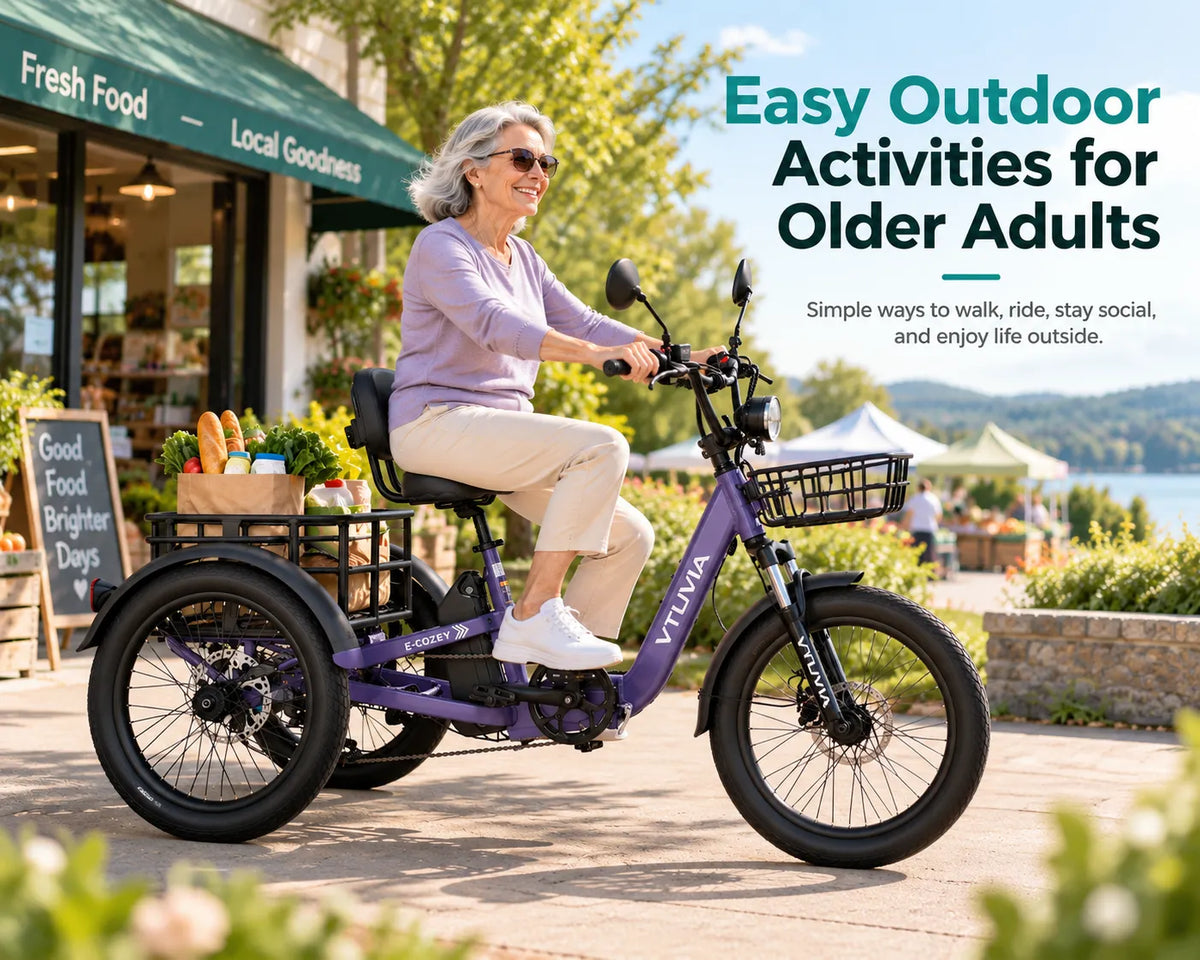
Grocery Run
You leave the store with several bags loaded into the rear basket.
A low center opening means you don't need to swing your leg over a tall frame or loaded cargo area.
The motor then helps reduce the additional effort created by the heavier ride home.
Tight Garage or Parking Space
Three-wheel bikes are larger than conventional bicycles, so manually pulling one backward can require additional effort.
E-COZY includes Reverse Mode to make backing out of garages, driveways, and parking areas more manageable.
Frequent Stops
Neighborhood rides often involve stop signs, crossings, parks, stores, and short breaks.
A low frame matters every time you get off and back on, not just at the beginning of the trip.
Smooth Starts
Starting from a complete stop can require more effort than cruising.
Torque-sensing electric assistance can help the rider get moving without relying entirely on leg power.

Who Benefits Most From a Low Step-Through Electric Trike?
A low step-through design isn't limited to one age group.
But it can be particularly useful for riders whose priorities have shifted from athletic cycling toward comfort, support, and easier everyday use.
Older Adults
Riders comparing electric trikes for seniors may value easier access, stable three-wheel support, and relaxed riding comfort more than maximum speed.
Riders With Reduced Flexibility
A lower frame opening reduces how high the leg needs to move while mounting or dismounting.
Returning Cyclists
Riders coming back after years away may appreciate the combination of three-wheel support and smooth electric assistance.
Comfort-Focused Riders
Forward pedaling, back support, and easier access create a more relaxed alternative to aggressive bicycle geometry.
Errand Riders
Grocery trips and repeated stops make easy entry, cargo capacity, and electric support especially useful.
Riders Seeking More Stability
Some riders simply prefer a three-wheel platform over balancing a conventional bicycle at low speeds.
Easy Access Should Work Together With Stable Everyday Control
Step-through height mainly determines how easily a rider enters and exits the frame.
It should not be treated as the only factor that affects stability or control.
A well-rounded electric trike also needs to consider how the vehicle behaves while moving, turning, stopping, and parking.
Rear Differential
Allows the two rear wheels to rotate at different speeds during a turn, supporting smoother cornering.
Hydraulic Braking
Provides controlled braking support during everyday riding, including loaded trips.
Parking Brake
Helps keep the trike stationary while the rider is loading, unloading, or preparing to ride.
Reverse Mode
Makes low-speed backing and tight-space maneuvering more convenient.
As with any three-wheel cycle, riders should still slow before turns, avoid abrupt steering, and follow the manufacturer's operating guidance.
For more on three-wheel handling, see Are Electric Trikes Safe? and our eTrike Safety guides.
What to Look For When Comparing Electric Trikes for Seniors
Motor size and battery range are important, but they should not be the only things on your comparison sheet.
| Question | Why It Matters |
|---|---|
| How high is the actual step-through? | Determines how much leg movement is needed every time you get on or off. |
| Where are the pedals positioned? | Affects leg extension, hip position, and overall riding posture. |
| Is there meaningful back support? | A backrest can work with the saddle and geometry to create a more supported seated position. |
| How does pedal assist respond? | Smooth assistance can make starts and low-speed riding easier to anticipate. |
| How will I use the trike? | Grocery trips, hills, frequent stops, and cargo all change what features matter most. |
| How does it feel after more than five minutes? | Long-ride comfort reveals more than a quick parking-lot test. |
Don't ask only, “How powerful is this electric trike?” Ask whether your body will still feel comfortable using it tomorrow.
How E-COZY Combines Easy Access With Everyday Comfort
E-COZY wasn't designed around one comfort feature.
The goal was to make the entire process— approaching the trike, getting on, sitting down, pedaling, carrying everyday cargo, stopping, and getting off— feel easier to manage.
For riders comparing electric trikes for seniors, E-COZY's advantage isn't one large specification.
It is the way easy access, riding position, electric assistance, stability, and everyday utility work together around the rider.
See E-COZY in Detail Find a Test RideVTUVIA E-COZY Electric Trike
14.8" ultra-low step-through with comfort-focused three-wheel design.

Frequently Asked Questions
What is a step-through electric trike?
A step-through electric trike uses an open center-frame design that reduces how high the rider needs to lift a leg when getting on or off.
Are step-through electric trikes easier to ride for seniors?
They can be easier to access for older riders because a lower opening reduces leg lift during mounting and dismounting. Overall ease of riding also depends on seating, pedal position, handlebar fit, braking, power delivery, and three-wheel handling.
Is a low step-through helpful for limited flexibility?
It can be. A lower entry area reduces how high the rider needs to lift a leg, which may make getting on and off feel more manageable for riders with reduced hip or knee mobility.
What is the E-COZY step-through height?
VTUVIA E-COZY uses a 14.8-inch ultra-low step-through designed to reduce unnecessary leg lifting when mounting and dismounting.
Does a low step-through make an electric trike more stable?
Not by itself. Step-through height mainly affects access. Overall stability also depends on frame geometry, rider position, wheel layout, tires, speed, weight distribution, turning behavior, and rider technique.
What else should I look for besides step-through height?
Compare seat and backrest support, pedal position, adjustable handlebar reach, braking, pedal-assist response, turning behavior, cargo capacity, overall dimensions, and how the trike feels during a real test ride.
Final Thoughts: Comfort Should Start Before You Pedal
Riders often begin comparing electric trikes by looking at motor wattage, battery range, top speed, and cargo capacity.
Those specifications matter, but they do not completely explain how a trike will feel during everyday riding.
For older adults, returning cyclists, and comfort-focused riders, the physical relationship between the rider and the trike deserves just as much attention.
Can you get on without an awkward leg movement? Does the riding position feel supported? Do the pedals sit naturally in relation to your hips? Does the electric assistance respond smoothly? Will the same setup still feel comfortable after a longer ride?
E-COZY approaches these questions as one connected design challenge.
Its 14.8-inch ultra-low step-through, forward-pedaling ComfortFit™ geometry, supportive seating, V-Adapt™ electric assistance, and everyday control features are designed to make three-wheel riding easier to approach and more comfortable to use.
Looking for a More Comfortable Electric Trike?
Explore E-COZY's ultra-low step-through frame, relaxed forward-pedaling position, supportive seating, and smooth electric assistance.
Explore the VTUVIA E-COZY Find a Test Ride


Share:
Are Electric Trikes Safe? What Every First-Time Rider Should Know
7 Short Car Trips You Can Replace With an Electric Trike