
ELECTRIC TRIKE SAFETY GUIDE
Understanding electric trike stability, turning behavior, tip-over risks, speed control, and the safety features that help riders feel more confident.

Electric trikes can provide a more confidence-inspiring way to ride for people who no longer feel comfortable balancing a traditional two-wheel bicycle, especially when starting, stopping, or riding at low speed.
However, three wheels do not make a trike risk-free. Safe riding still depends on speed, steering, braking, road slope, cargo placement, rider fit, and practice. If you are new to three-wheel riding, start with our Complete Electric Trike Guide and browse more eTrike Safety resources.
Are Electric Trikes Safe? The Quick Answer
Electric trikes can be safe for many riders when the trike fits the rider well, the route is appropriate, and the rider understands three-wheel handling.
Their three-wheel platform removes the need to balance the vehicle at a complete stop, which can help many beginners and older adults feel more confident. However, an electric trike does not lean into a corner like a bicycle. Entering a turn too quickly, riding across a steep side slope, loading cargo unevenly, or steering abruptly can increase the risk of an inside wheel lifting or the trike tipping sideways.
The safest approach is to slow down before every turn, practice in an open area, learn the width of the rear wheels, and choose a trike with predictable power delivery, effective brakes, a low riding position, and stable handling.
What Does “Safe” Mean on an Electric Trike?
For most riders, electric trike safety is not one single feature. It is the combination of stability at a stop, predictable braking, manageable speed, rider fit, route choice, and turning technique.
Where a Trike Can Feel Safer
- No need to balance the vehicle at a complete stop.
- More confidence during slow starts and stops.
- More room for a supportive saddle and backrest.
- Three-wheel support can reduce low-speed wobble concerns.
Where Riders Still Need Practice
- Turning without leaning like a bicycle.
- Managing speed before corners and downhill sections.
- Understanding rear-wheel width and clearance.
- Keeping cargo low, centered, and balanced.
This is why a short test ride can be especially valuable for first-time trike riders. It lets you feel how the trike starts, stops, turns, and fits your body before deciding whether the design is right for you.
What Do the Injury Data Tell Us?
Safety concerns are understandable, especially for riders who are returning to cycling after several years or who are worried about the consequences of a fall.
According to the U.S. Centers for Disease Control and Prevention, nearly 1,000 bicyclists die annually in road crashes involving motor vehicles, and approximately 120,000 bicyclists are treated in emergency departments each year for nonfatal crash-related injuries.
The CDC reports nearly 1,000 bicyclist deaths each year in U.S. road crashes involving motor vehicles.
This is the CDC estimate for bicyclists treated annually for nonfatal crash-related injuries.
Current national databases do not provide a reliable standalone annual injury count for adult electric trikes.
Important data limitation: These numbers should not be described as electric-trike injury totals. The CDC bicycle category cited here includes pedal-powered cycles such as bicycles and tricycles. The CDC notes that e-bicycle injuries are currently counted with motorcycle injuries.
These statistics therefore provide context about the consequences of cycling crashes, but they cannot tell us how often electric trike riders are injured or whether electric trikes are safer than e-bikes overall.
How Many Electric Trike Injuries Occur?
There is currently no comprehensive national database that publishes a dependable annual number of injuries involving adult electric trikes alone.
Electric trike incidents may be recorded under broader categories such as bicycles, e-bikes, motorcycles, consumer products, or unspecified wheeled transportation.
In January 2026, the U.S. Consumer Product Safety Commission warned consumers to stop using specific Liberty Trike 16-inch and 20-inch electric tricycles because they could tip over while turning.
The CPSC investigated six reports of falls involving injuries such as concussions, fractures, and contusions. It also stated that fall risk was greater on slopes and uneven surfaces.
This warning applies to those specific models and should not be used to claim that every electric trike has the same problem. It does demonstrate why turning stability should be treated as a central design and riding priority.
Why Can a Three-Wheel Electric Trike Tip Over?
Three wheels provide an important advantage: the rider does not need to balance the vehicle while standing still. But a three-wheel vehicle also follows different cornering physics from a bicycle.
The Support Triangle
The three tire contact points form a triangular support area underneath the rider and vehicle. As long as the combined center of gravity remains inside this area, the trike remains supported by all three wheels.
During a fast or abrupt turn, lateral force shifts the effective load toward the outside wheel. If the combined center of gravity moves beyond the side of the support triangle, the inside rear wheel may become lighter and begin to lift.

Three wheels improve stationary stability, but they do not remove the laws of physics during a fast turn.
Electric Trike vs. E-Bike: Where Does a Trike Feel More Stable?
An electric trike and a two-wheel e-bike provide different types of stability. Neither design is automatically safer in every situation. For a broader comparison, read Is an Electric Trike Easier to Ride Than an E-Bike?.
Two-Wheel E-Bike
- The rider must balance while starting and stopping.
- The bike can fall sideways at very low speed or at a complete stop.
- The rider and bicycle lean together through a turn.
- Experienced riders often find cornering smooth and natural.
Three-Wheel Electric Trike
- The rider does not need to balance the trike at a complete stop.
- Starting and stopping may feel more confidence-inspiring.
- The wider platform can support cargo and a larger seat.
- The trike remains more upright instead of leaning naturally.
- Turns require active speed control and steering awareness.
Why Does Turning an Electric Trike Feel Different?
Many first-time riders describe electric trike steering as stiff, awkward, or less fluid than a bicycle. That sensation usually comes from the difference between leaning and steering.
How an E-Bike Turns
On a two-wheel bicycle, the rider naturally shifts body weight and leans inward. The bicycle leans with the rider, helping the curved path feel smooth.
How an Electric Trike Turns
A trike stays more upright. The rider changes direction mainly by steering the front wheel while managing speed and keeping the body controlled.
A trike requires a new habit: slow first, steer smoothly, and accelerate after the turn.
Why Speed Is the Biggest Electric Trike Safety Factor
Speed has an outsized effect on cornering force. A turn that feels comfortable at low speed may feel completely different when entered only a few miles per hour faster.
The safest electric trike turn begins before the handlebars move: reduce your speed first.
A Safer Turning Sequence
- Look ahead and identify the turn early.
- Reduce speed before entering the corner.
- Keep both hands on the handlebars.
- Steer smoothly instead of making a sudden input.
- Keep your body controlled and avoid abrupt leaning.
- Wait until the trike is straight before accelerating strongly.
What Increases the Risk of a Side Tip-Over?
Tip-over risk rarely comes from one factor alone. It is usually the result of speed interacting with road conditions, rider movement, cargo placement, or vehicle geometry.
- Entering a tight turn too quickly
- Steering abruptly at speed
- Turning while traveling downhill
- Riding across a steep side slope
- Hitting a curb or raised edge with one wheel
- Loading heavy cargo high above the frame
- Placing most cargo on one side
- Using excessive pedal assist during a turn
- Standing or moving suddenly while cornering
- Riding with incorrect tire pressure
The solution is not to fear every turn. It is to increase the available safety margin by reducing speed, keeping cargo low and balanced, choosing smoother routes, and learning how the trike responds.
How Can Modern Electric Trike Design Reduce the Risk?
No design feature can make a trike impossible to tip, and good engineering cannot replace responsible riding. However, several design decisions can make the trike easier to control and more predictable.
Lower Center of Gravity
Positioning the rider, battery, frame, and cargo closer to the ground can help keep the combined center of gravity farther inside the support area.
Wide and Balanced Rear Stance
Rear-wheel spacing influences the size of the trike's support triangle and available stability margin.
Rear Differential
During a turn, the outside rear wheel travels farther than the inside wheel. A differential allows the two rear wheels to rotate at different speeds, reducing tire scrub and improving cornering smoothness.
Hydraulic Disc Brakes
Effective brakes help riders reduce speed before entering a turn and maintain more controlled stopping behavior.
Predictable Power Delivery
A well-calibrated torque sensor and controller can provide assistance in a smoother, more proportional way.
Low Step-Through Frame
A low step-through can make mounting and dismounting easier and reduce the need to lift a leg high over the frame.
Supportive Seat and Backrest
A comfortable, well-adjusted riding position helps the rider maintain consistent control of the handlebars, pedals, brakes, and body position. You can explore more fit-focused guidance in our eTrike Comfort articles.
Parking Brake and Reverse Mode
A parking brake helps prevent unwanted movement while stopped. Reverse mode can reduce the need to manually push a heavier trike in tight spaces.
How the E-COZY Helps Riders Feel More in Control
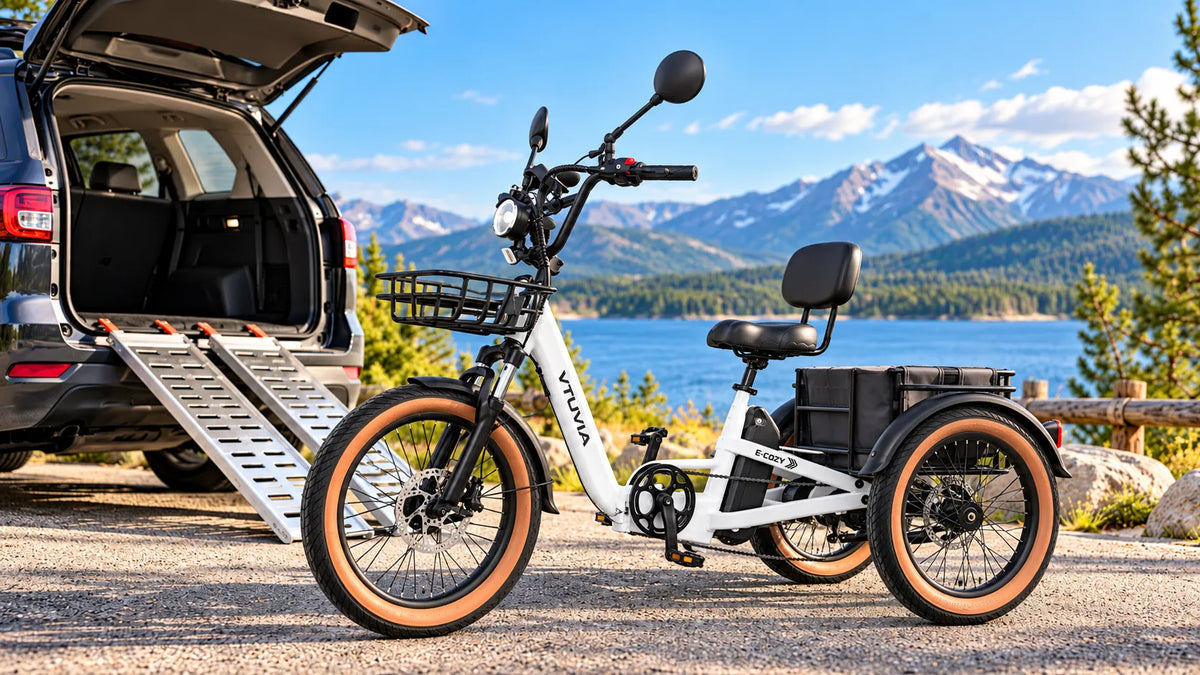
The E-COZY is designed for riders who still want to pedal and steer, but prefer a more comfortable, stable, and predictable experience than a traditional two-wheel e-bike.

Stable at a Stop, Predictable Through the Ride
E-COZY removes the need to balance the trike at a complete stop while giving riders controlled braking, smooth assistance, and a supported riding position.
It is still important to slow down before corners and learn three-wheel handling, but thoughtful design can make that learning experience more approachable.
Safety Features That Work Together
E-COZY does not rely on one feature to create rider confidence. Its frame, controls, braking system, drivetrain, and seating position are designed to work together.
-
14.8-inch ultra-low step-through Reduces the height riders must step over when getting on or off.
-
Rear differential Allows the rear wheels to rotate at different speeds while turning for smoother cornering behavior.
-
Hydraulic disc brakes Provide controlled braking to help the rider reduce speed before turns and stops.
-
Torque-sensing assistance Delivers assistance in response to pedaling input for a more natural and predictable feel.
-
Adjustable seat and backrest Helps riders find a supported position for steering, braking, and everyday comfort.
-
Parking brake and reverse mode Help riders manage stops, cargo loading, and low-speed positioning more conveniently.
E-COZY riders should slow down before turns, avoid steep side slopes, balance cargo, wear a helmet, and practice in an open area before entering traffic.
VTUVIA E-COZY Electric Trike
Designed around comfort, safety, stability, and everyday control.

Electric Trike Safety Checklist Before Your First Ride
Your first practice session should focus on control rather than distance or speed. Choose a large, level, traffic-free area and give yourself time to learn.
- Wear a properly fitted bicycle helmet
- Adjust the seat and backrest before riding
- Check tire pressure and brake operation
- Begin with the lowest pedal-assist level
- Practice starting without turning
- Practice smooth, progressive braking
- Make wide turns at walking speed
- Learn the width of the rear wheels
- Practice looking ahead instead of at the front tire
- Ride without cargo during the first session
- Test reverse mode at very low speed
- Avoid traffic until steering feels predictable
Practice This Simple Exercise
- Ride forward in a straight line at low speed.
- Brake smoothly and come to a complete stop.
- Make a large circle in each direction.
- Gradually make the circles smaller without increasing speed.
- Practice slowing before the circle and accelerating after it.
- Set up two visible markers and practice a wide figure-eight.
Electric Trike Safety: Myth vs. Fact
Three wheels mean an electric trike cannot tip over.
A trike can tip if it enters a turn too quickly, crosses a steep side slope, strikes an obstacle, or carries an unstable load.
An electric trike turns exactly like a bicycle.
A bicycle leans naturally through a turn. A trike remains more upright and depends more heavily on steering and speed control.
A more powerful motor automatically makes a trike safer.
Motor power can help on hills, but predictable delivery and responsible speed management are more important for control.
Experienced bicycle riders do not need to practice on a trike.
Bicycle experience helps with traffic awareness and braking, but leaning habits can make the first trike turns feel unfamiliar.
A differential makes an electric trike impossible to tip.
A differential can improve turning smoothness, but riders must still slow down and avoid abrupt or high-speed cornering.
Frequently Asked Questions About Electric Trike Safety
Are electric trikes safe for seniors?
They can be a good option for older adults who want three-wheel support and less dependence on two-wheel balance. Safety still depends on rider fit, route conditions, speed, braking, and learning how a trike turns.
Can an electric trike tip over?
Yes. Tip-over risk can increase during fast or abrupt turns, on steep side slopes, when hitting obstacles, or when cargo is loaded unevenly.
Are electric trikes safer than e-bikes?
Electric trikes remove the need to balance at a complete stop, while e-bikes lean naturally through turns. Neither is automatically safer in every situation; rider ability, route, speed, and vehicle design all matter.
Why does an electric trike feel different when turning?
A bicycle leans with the rider through a turn. A trike stays more upright and changes direction mainly through steering, so new riders need to learn a different cornering habit.
What safety features should I look for on an electric trike?
Useful features can include effective brakes, predictable motor assistance, a rear differential, a low step-through frame, a supportive riding position, appropriate tires, and a parking brake.
How should a beginner practice on an electric trike?
Start in a flat, open, traffic-free area. Practice straight starts, smooth braking, wide turns, rear-wheel clearance, and low-speed control before riding in traffic.
Are electric trikes safe on hills?
They can be used on suitable hills within manufacturer recommendations, but downhill speed, side slopes, traction, braking distance, and cargo weight all affect safety.
Sources and Safety References
- U.S. Centers for Disease Control and Prevention, “Bicycle Safety.” View CDC bicycle safety information.
- U.S. Consumer Product Safety Commission, warning regarding specific Liberty Trike models and turning-related fall hazards. View the CPSC warning.

Share:
Electric Trike vs. Mobility Scooter: Which One Fits Your Lifestyle Better?
Why Step-Through Electric Trikes Are Easier to Ride