
If you’ve been shopping for an electric bike, you’ve probably noticed that mid-drive e-bikes often cost more than hub-motor models. So what are you actually paying for—and is a mid-drive really worth it?

For many riders, the answer isn’t simply “more power.” A mid-drive motor changes where the power comes from, how the bike feels under acceleration, and how naturally the motor works with your pedaling.
That can make a noticeable difference if your rides include hills, longer commutes, frequent stops, or changing terrain.
But a mid-drive isn’t automatically the best choice for everyone. Here’s what you should understand before deciding whether it’s worth paying more.
What Is a Mid-Drive E-Bike?
Most electric bikes use one of two common motor layouts: hub-drive or mid-drive.
Mid-drive motor: The motor is mounted near the pedals, close to the center of the bike.
The location of the motor changes how power reaches the bike.
A hub motor powers the wheel directly. A mid-drive motor sends power through the bike’s drivetrain, allowing the motor to work together with the bicycle’s gearing.
To the rider, that often creates a more natural feeling—closer to having stronger legs rather than feeling like the wheel is simply pushing the bike forward.
Why Do Riders Choose Mid-Drive E-Bikes?
1. More Natural Pedal Assist
One of the biggest reasons riders choose a mid-drive system is how the assistance feels.
Because power is delivered close to the center of the bike and works with the drivetrain, acceleration can feel smooth and progressive rather than like a separate motor pushing from one wheel.
This is especially noticeable when a bike also uses responsive pedal-assist sensing. For riders coming from a traditional bicycle, that natural feeling can make an e-bike feel more intuitive.
2. Better Suited to Hills
Hills are one of the strongest reasons to consider a mid-drive e-bike.
Because a mid-drive motor can work through the bike’s gears, shifting into an easier gear can help both the rider and motor tackle climbs more effectively.
That makes mid-drive systems especially attractive for:
- Hilly neighborhoods
- Longer climbs
- Daily commuting routes with elevation changes
- Riders carrying additional cargo
- Longer recreational rides with mixed terrain
A hub motor can still handle hills, especially when it is properly sized for the bike and rider. But if climbing is a regular part of your ride rather than an occasional challenge, motor placement becomes more important.
3. More Balanced Weight Distribution
Mounting the motor near the center of the bike keeps more weight low and centralized instead of placing a heavy motor inside one wheel.
That can make the bike feel more balanced when turning, maneuvering at lower speeds, riding through traffic, or moving across uneven pavement.
Mid-Drive vs. Hub Motor: Which Makes More Sense?
Neither system is automatically better for every rider. The better choice depends on where, how often, and how far you ride.
| Feature | Mid-Drive | Hub Motor |
|---|---|---|
| Power Feel | More natural and integrated | More direct motor assistance |
| Hills | Strong advantage because it can work with the bike’s gears | Performance depends more heavily on motor setup |
| Weight Balance | More centralized | More weight concentrated in one wheel |
| Uses Bike Gears | Yes | Usually no |
| Typical Price | Usually higher | Usually more affordable |
| Best For | Hills, commuting, frequent riding, longer trips | Casual riding, flatter terrain, value-focused riders |
If most of your riding is short, flat, and recreational, a hub-motor e-bike may already do everything you need.
But if you commute regularly, deal with hills, or care about a more natural pedal-assist feel, a mid-drive becomes much easier to justify.
Why Do Mid-Drive E-Bikes Usually Cost More?
The motor itself is only part of the story.
A mid-drive system typically requires closer integration between the motor, crank area, drivetrain, sensors, and frame. That added integration is one reason many mid-drive e-bikes sit above entry-level hub-motor models in price.
It’s whether the difference in ride quality, hill performance, balance, and everyday usability matters enough for the way you ride.
This is also why a mid-drive e-bike priced around the $1,400 range can stand out—especially if the rest of the bike is designed around commuting and everyday use.
What Does $1,399 Get You in a Mid-Drive E-Bike?
During VTUVIA’s 10th Anniversary Sale, the CMB is currently $1,399, down from $1,899.

VTUVIA CMB Mid-Drive E-Bike
A city-focused mid-drive e-bike built around smooth power, everyday comfort, longer-range capability, and practical commuting.
- 500W mid-drive motor
- Up to 80-mile range
- Step-through frame
- Torque and cadence sensing
- Built for commuting, hills, and everyday riding
What About Everyday Handling?
Motor performance matters, but an e-bike also has to be easy to live with. Commuters regularly need to move a bike through garages, sidewalks, parking areas, apartments, or storage spaces.

For that reason, weight distribution, frame design, and how manageable the bike feels off the saddle can matter just as much as a headline motor number.
Step-Through Design Matters More Than You Think
A step-through frame isn’t only about comfort. It can make everyday riding easier when your route involves frequent stops, traffic lights, errands, or getting on and off the bike several times during one trip.

Who Should Consider a Mid-Drive E-Bike?
A mid-drive commuter like the CMB makes the most sense if several of these sound familiar:
- You regularly ride hills.
- You commute several times per week.
- You prefer smoother, more natural pedal assistance.
- You care about balanced weight distribution.
- You take longer rides.
- You want easier step-through access.
- You’ve wanted a mid-drive but don’t want to move into a $2,000+ price range.
On the other hand, if your rides are short, mostly flat, and occasional, a hub-motor e-bike may still be the more sensible value.
So, Is a Mid-Drive E-Bike Worth the Extra Money?
For the right rider, yes.
The biggest reason to choose a mid-drive isn’t simply that the motor is mounted in a different place. It’s the combination of:
Those advantages matter most when you ride often enough to notice them.
If your e-bike is mainly for the occasional weekend cruise, you may not need to pay extra for a mid-drive.
But if an e-bike is becoming part of your commute, daily transportation, or regular riding routine, a mid-drive can be a meaningful upgrade.
Mid-Drive Without the Premium Price
The VTUVIA CMB is currently $1,399 during our 10th Anniversary Sale, saving $500 from its previous $1,899 price.
Shop the CMB →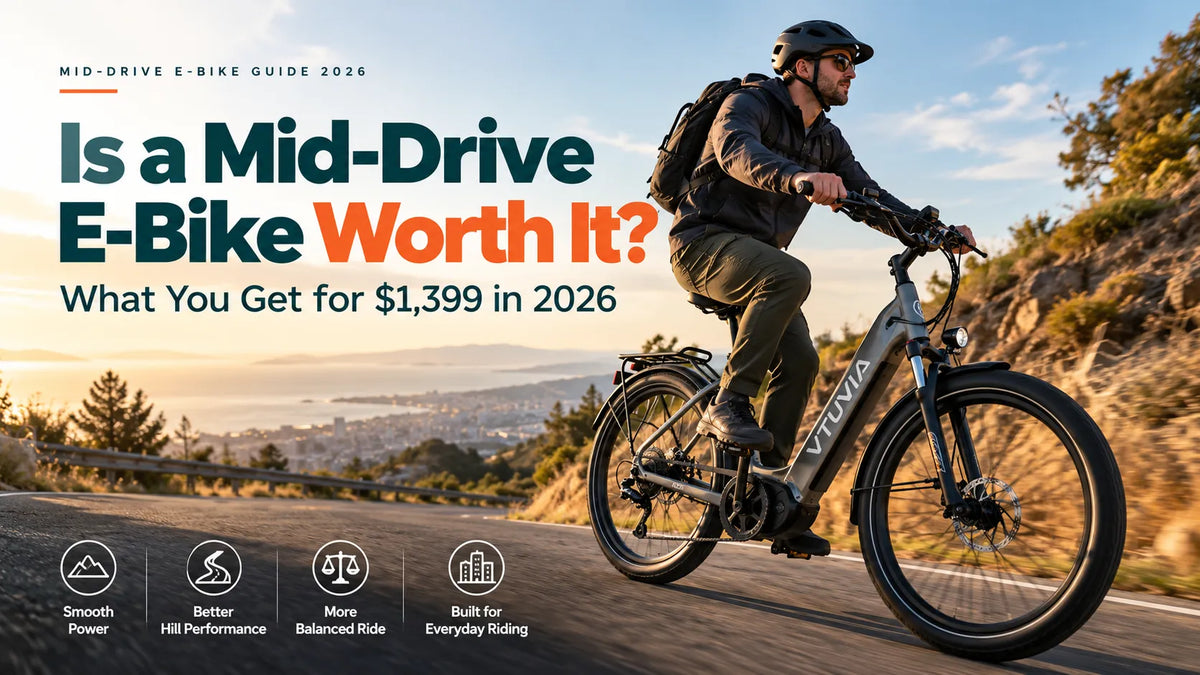
Share:
How to Transport an Electric Trike: SUV, Truck, Trailer & RV Guide