

A comfortable electric trike is not created by adding a larger seat to a standard frame. True comfort comes from how the frame, pedals, saddle, backrest, handlebars, controls, and three-wheel platform work together around the rider.
That is the idea behind the E-COZEY ComfortFit™ Ergonomic System: an integrated rider-first design developed to reduce unnecessary body movement, provide more natural support, and make every stage of the ride feel easier—from getting on to getting off.
Quick answer: The ComfortFit™ Ergonomic System combines an exceptionally low 14.8-inch step-through frame, forward-pedaling semi-recumbent geometry, adjustable back support, a low center of gravity, a wide rear track, and smooth power delivery. Instead of treating comfort as one isolated feature, the system considers how the rider moves, sits, pedals, steers, stops, and maintains control throughout the entire ride.
Why Electric Trike Comfort Is More Than a Large Seat
Many electric trikes are marketed as comfortable because they include a wide saddle or extra padding. A supportive seat can certainly improve the experience, but the seat is only one point of contact between the rider and the trike.
A rider's comfort is also affected by:
- How high the leg must lift when getting on
- Where the pedals sit in relation to the hips
- How much the torso must lean forward
- Whether the lower back receives meaningful support
- How much body weight rests on the hands and shoulders
- How the knees move through each pedal stroke
- Where the rider's weight sits within the three-wheel platform
- How smoothly the motor responds when the rider begins pedaling
When these elements are not considered together, a trike may look comfortable while still causing the rider to feel unsupported, tense, or tired after a longer ride.
ComfortFit™ approaches the problem differently. Instead of beginning with individual components, it begins with the rider's complete experience.
Comfort is not one feature. It is the result of how the rider's body interacts with the entire trike.
What Is the ComfortFit™ Ergonomic System?
The ComfortFit™ Ergonomic System is E-COZEY's integrated approach to electric trike comfort, support, and rider confidence. It connects multiple design decisions that are often treated separately.
Easy Mounting
A 14.8-inch ultra-low step-through reduces the need to lift the leg high over the frame.
Natural Riding Position
Forward-positioned pedals create a semi-recumbent posture that allows the rider to sit more naturally.
Meaningful Body Support
An adjustable saddle and supportive backrest help the body remain relaxed during longer rides.
Relaxed Upper Body
A more upright posture can reduce the amount of body weight placed on the wrists, arms, shoulders, and neck.
Balanced Stability
A lowered frame and carefully managed weight position help keep the rider closer to the trike's center of gravity.
Confident Handling
A wide rear track, rear differential, and balanced geometry work together to create more predictable control.
Smooth Control
A torque sensor and tuned controller deliver assistance progressively rather than producing an abrupt surge.
Everyday Ease
The system is designed around repeated real-life actions: mounting, riding, slowing, stopping, parking, and starting again.
 These are not unrelated upgrades. Each element supports the others. The low entry helps the rider get into position, the semi-recumbent geometry creates a more relaxed posture, the backrest supports that posture, and the balanced frame helps the rider feel more settled within the trike.
Ultra-Low Step-Through for Easier Mounting
ComfortFit™ Principle 1
Every ride begins with getting on the trike. For riders with limited flexibility, reduced range of motion, knee discomfort, hip stiffness, or concerns about balance, this can be one of the most difficult parts of the experience.
Traditional bicycle frames may require the rider to lift one leg over a high top tube or swing it behind the saddle. Even many step-through trikes still require more leg lift than some riders find comfortable.
E-COZEY uses an exceptionally low 14.8-inch step-through height. The open frame reduces the amount of vertical movement required when mounting or dismounting.
Why does a lower step-through matter?
- It reduces the need to lift the knee and hip high over the frame.
- It makes repeated stops during errands easier to manage.
- It can help riders place themselves on the saddle more deliberately.
- It makes getting back on after a rest, shopping stop, or park visit feel less demanding.
- It can increase confidence before the trike even begins moving.
The benefit is not limited to one difficult mounting motion. During a typical outing, a rider may get on and off several times. A lower entry can reduce effort during every repetition.
Design idea: Reducing unnecessary leg lift makes the entire ride easier because comfort begins before the wheels start moving.
Semi-Recumbent Geometry for a More Natural Riding Position
After mounting, the rider's position becomes the most important part of long-term comfort. This is where E-COZEY differs from many conventional electric trikes.
On a traditional upright bicycle, the pedals are located almost directly below the rider. This can work well for athletic cycling, but it may also encourage the rider to lean forward, place more weight on the hands, and rely on the core muscles to hold the torso in position.
E-COZEY moves the bottom bracket and pedals forward to create a semi-recumbent riding position. Instead of pedaling almost directly beneath the body, the rider pedals slightly forward while remaining seated in a supported position.

What is a semi-recumbent riding position?
A semi-recumbent position sits between a traditional upright bicycle and a fully recumbent cycle. The rider is not lying down. Instead, the hips remain comfortably supported while the legs extend forward through the pedal stroke.
This geometry can help create:
- A more open and relaxed body position
- Less need to lean heavily over the handlebars
- A more natural relationship between the hips, knees, and pedals
- More effective use of the saddle and backrest for support
- A riding posture that feels less demanding over time
The goal is not to eliminate physical activity. The goal is to place the rider in a position where pedaling feels natural and the body does not have to perform unnecessary work simply to remain comfortable.
| Riding Element | Traditional Upright Geometry | ComfortFit™ Semi-Recumbent Geometry |
|---|---|---|
| Pedal position | Located more directly beneath the rider | Moved forward to support a more relaxed leg position |
| Torso position | May require more forward lean | Encourages a more open and upright posture |
| Back support | Often limited or absent | Works together with an adjustable supportive backrest |
| Upper-body load | More weight may rest on the hands and handlebars | More body weight remains supported by the saddle and backrest |
| Long-ride feeling | Can feel active or demanding depending on setup | Designed to feel more supported and relaxed |
Adjustable Back Support for Longer Rides
A large saddle may support the rider's weight, but it does not automatically support the rider's posture. Without meaningful back support, the lower back and core muscles may still need to work continuously to keep the torso upright.
This can create a feeling that some riders describe as sitting on the trike rather than sitting securely within it.
E-COZEY combines its semi-recumbent geometry with a supportive, adjustable backrest. The backrest is not simply an accessory attached to the seat. It is an important part of the riding position.

Why does back support matter?
- It gives the torso a stable point of support.
- It reduces the need for the core muscles to remain constantly engaged.
- It allows the rider to settle into the semi-recumbent riding position.
- It can help reduce the unsupported feeling common on basic trike saddles.
- Its adjustability helps accommodate different rider sizes and preferred sitting positions.
The combination matters. Forward-positioned pedals without back support may still leave the rider searching for a stable posture. A backrest without suitable frame geometry may feel like an add-on. ComfortFit™ is designed so the pedals, saddle, and backrest support one another.
Design idea: A soft seat supports the rider's weight. A properly designed seating system supports the rider's entire posture.
A More Relaxed Position for the Hands, Shoulders, and Neck
Electric trike comfort is often discussed only in terms of the knees, hips, and lower back. The upper body matters just as much.
When a rider leans forward, part of the upper body's weight may be transferred through the shoulders, arms, wrists, and hands. Over time, an unsuitable riding position can contribute to tired shoulders, hand pressure, wrist discomfort, or a tense neck.
The ComfortFit™ semi-recumbent position is designed to keep more of the rider's weight supported by the saddle and backrest. This helps the handlebars function primarily as a steering control rather than as a place for the rider to hold up the upper body.
A more relaxed upper body can support:
- A more neutral wrist and hand position
- Less pressure through the arms and shoulders
- A more natural neck angle when looking ahead
- Better forward visibility without excessive head lifting
- A calmer, less tense feeling during casual riding
Handlebar and saddle adjustment remain important because every rider has different proportions. The purpose of the system is to provide a position that can be adjusted around the rider rather than forcing the rider to adapt to a fixed posture.
Low Center of Gravity for Balanced Stability
Three wheels can provide additional support at a stop, but three wheels alone do not guarantee that every electric trike will feel equally stable.
Frame height, rider position, component placement, rear track width, steering geometry, speed, and weight distribution all influence how a trike feels during starts, stops, and turns.

E-COZEY lowers key parts of the frame and rider position to help keep the overall center of gravity closer to the ground. The lowered bottom bracket contributes to both the ultra-low entry and the lower riding position.
Why does the center of gravity matter?
- A lower rider position can create a more settled feeling within the trike.
- It can reduce the sensation of sitting high above the rear wheels.
- It helps the frame manage the rider's weight more predictably.
- It supports greater confidence at low speeds and during controlled turns.
- It reduces the amount of corrective body movement the rider may feel compelled to make.
This last point is especially important. When a trike feels unpredictable, the rider may tense the shoulders, grip the handlebars harder, or shift the upper body unnecessarily. A balanced platform helps the rider remain more relaxed.
Stability is not only about the number of wheels. It is also about where the rider and the trike's weight are positioned.
Wide Rear Track and Differential for Confident Handling
The distance between the rear wheels plays an important role in lateral stability. A wider rear track creates a broader support base beneath the rider.
E-COZEY combines its wide rear stance with balanced frame geometry, 20 × 3-inch tires, and a rear differential.
What does the rear differential do?
During a turn, the outside rear wheel must travel farther than the inside rear wheel. A differential allows the two rear wheels to rotate at different speeds instead of forcing them to move identically.
This can support:
- Smoother and more natural turning
- Less tire scrubbing during corners
- More predictable low-speed handling
- A calmer steering experience
- Less need for the rider to compensate with abrupt body movement
The wide rear track, low center of gravity, tire contact, and differential should not be viewed as separate selling points. They form a coordinated handling platform.
As with any three-wheel cycle, riders should still slow down before turning, keep both hands on the handlebars, and avoid sharp steering movements at higher speeds. Good geometry supports confident handling, but responsible riding remains essential.
Smooth, Natural Power That Is Easier to Manage
Ergonomics is not limited to the shape of the frame. It also includes how the trike responds to the rider.
Sudden motor assistance can cause the rider's body to tense, shift backward, or grip the handlebars more firmly. This can be especially uncomfortable when starting from a stop or maneuvering at low speed.
E-COZEY uses a torque sensor and an intelligently tuned controller to deliver assistance in a more progressive and predictable way.
How does a torque sensor change the riding experience?
A torque sensor measures how much pressure the rider applies to the pedals. Instead of delivering the same response every time the pedals move, the system can provide assistance that better matches the rider's input.
The result is designed to feel more like an extension of the rider's own effort:
- Gentle pedal pressure produces gentle support.
- Stronger pedal pressure produces more assistance.
- Starts can feel smoother and easier to anticipate.
- The rider has less need to react to an abrupt surge.
- Power delivery feels connected to the natural pedaling rhythm.
This smoother response supports the larger ComfortFit™ goal: helping the rider remain relaxed and in control rather than requiring the body to compensate for unpredictable movement.
Designed Around the Complete Ride Cycle
Riders do not experience an electric trike only while cruising in a straight line. A real outing includes many different actions:
- Approaching the trike
- Stepping through the frame
- Settling onto the saddle
- Positioning the feet on the pedals
- Starting from a stop
- Pedaling and steering
- Slowing down
- Parking
- Getting off
- Returning and starting again
A rider may repeat this cycle several times during one grocery trip, visit to a farmers market, neighborhood ride, or afternoon in the park.
ComfortFit™ is designed around this complete Mount → Ride → Stop experience.
| Ride Stage | ComfortFit™ Design Support | Intended Rider Benefit |
|---|---|---|
| Mount | 14.8-inch ultra-low step-through | Less leg lift and easier access to the saddle |
| Sit | Adjustable saddle and supportive backrest | A more secure and supported body position |
| Pedal | Forward-pedaling semi-recumbent geometry | A more natural and relaxed riding posture |
| Start | Torque sensor and tuned controller | Smoother, more predictable assistance |
| Ride | Low center of gravity and balanced weight distribution | A more settled feeling within the trike |
| Turn | Wide rear track, 20 × 3-inch tires, and differential | More predictable and natural handling |
| Stop and park | Hydraulic braking, parking brake, and practical controls | Greater confidence during everyday stops |
| Dismount | Open ultra-low frame | Less effort when stepping away from the trike |
Looking at the complete cycle changes how electric trike comfort is understood. The goal is not simply to make the middle of the ride comfortable. It is to reduce unnecessary effort throughout the entire experience.
Who Can Benefit from Ergonomic Electric Trike Design?
ComfortFit™ was developed for riders who value comfort, stability, and confidence more than an aggressive or athletic riding posture.
This may include:
- Adults returning to cycling after years away
- Riders who find it difficult to lift a leg over a traditional frame
- Older adults looking for a more supportive riding position
- People who prefer less pressure on the hands, shoulders, or lower back
- Riders who want a more natural position for neighborhood and recreational riding
- People who make frequent stops while shopping or running errands
- Riders who want to remain active without adopting an aggressive cycling posture
- Anyone who feels unsupported on a traditional bicycle saddle
No single riding position is ideal for every person. Rider height, leg length, flexibility, mobility, and personal preference all matter. An adjustable saddle and backrest allow the E-COZEY setup to be adapted to different riders while preserving the system's core semi-recumbent geometry.
ComfortFit™ Is a System, Not a List of Features
It would be easy to describe E-COZEY as an electric trike with a low frame, a large saddle, a backrest, wide tires, and a differential. However, that description misses the reason these features exist.
The real purpose is to help the rider:
- Move less when getting on and off
- Sit in a more natural position
- Receive meaningful back and body support
- Place less weight through the hands and shoulders
- Feel more settled within the three-wheel platform
- Pedal without reacting to sudden assistance
- Complete everyday rides with less physical and mental tension
Each design choice contributes to the same result. That shared purpose is what makes ComfortFit™ an ergonomic system rather than a collection of unrelated components.
Every detail of the E-COZEY rider interface is designed to reduce unnecessary movement, support the body naturally, and make riding feel easier from the moment you step on to the moment you step off.
Frequently Asked Questions
What makes an electric trike ergonomic?
An ergonomic electric trike considers the relationship between the rider and the entire vehicle. Important factors include step-through height, pedal position, saddle and back support, handlebar reach, wrist position, knee movement, center of gravity, weight distribution, and motor response.
What is semi-recumbent electric trike geometry?
Semi-recumbent geometry places the pedals farther forward than on a traditional upright bicycle. The rider remains seated upright rather than lying down, while the legs extend forward through the pedal stroke. This position is designed to work together with a supportive saddle and backrest.
Is a semi-recumbent trike the same as a recumbent trike?
No. A fully recumbent trike places the rider much lower and farther back, often with the legs extended almost horizontally. A semi-recumbent electric trike keeps the rider in a more upright and familiar position while moving the pedals forward for improved support and comfort.
Why is the E-COZEY step-through height important?
The 14.8-inch step-through reduces the amount of leg lift needed to enter or exit the frame. This can make mounting and dismounting easier, particularly for riders with limited flexibility or reduced range of motion.
Does a backrest make an electric trike more comfortable?
A properly positioned backrest can provide meaningful torso support and reduce the need for the rider's core muscles to remain constantly engaged. Its effectiveness depends on how well it works with the saddle, pedal position, and overall frame geometry.
Why does the center of gravity matter on an electric trike?
A lower center of gravity can help the rider feel more settled within the trike. It also supports more predictable weight distribution during starts, stops, and controlled turns. Riders should still reduce speed before turning and follow safe trike-riding practices.
What is the purpose of a wide rear track?
A wide rear track creates a broader support base between the rear wheels. Combined with low frame geometry and proper weight distribution, it can contribute to a more stable and confidence-inspiring ride.
How does a rear differential improve electric trike handling?
A rear differential allows the inside and outside rear wheels to rotate at different speeds during a turn. This supports smoother cornering and reduces the tire scrubbing that can occur when both rear wheels are forced to rotate at the same speed.
How does a torque sensor improve comfort?
A torque sensor responds to the rider's actual pedal pressure. This allows motor support to build in a way that feels more connected to the rider's effort, helping reduce abrupt acceleration and making low-speed control easier to anticipate.
Is the E-COZEY ComfortFit™ system only for older adults?
No. Although many older riders may appreciate the low entry, supportive seating, and relaxed geometry, the system can also benefit returning cyclists, casual riders, people making frequent stops, and anyone who prefers a more comfortable alternative to an aggressive bicycle posture.
Can taller or shorter riders use semi-recumbent geometry?
Rider fit depends on height, inseam, reach, and personal preference. Adjustable saddle, backrest, and handlebar settings help accommodate different body types. Riders should always confirm the recommended fit range before purchasing.
Does an ergonomic design guarantee that a trike cannot tip?
No electric trike is impossible to tip. Frame geometry, center of gravity, rear track width, tires, and differential design can support more confident handling, but riders must still slow down before corners, avoid abrupt steering, and operate the trike according to the manufacturer's safety guidance.
Final Thoughts: A More Comfortable Ride Starts Before You Pedal
Riders often begin comparing electric trikes by looking at motor wattage, battery range, top speed, and cargo capacity. These specifications matter, but they do not fully explain how a trike will feel after twenty or thirty minutes of riding.
Long-term comfort begins with the rider's physical relationship to the trike.
Can the rider get on without a difficult leg movement? Do the hips, knees, and pedals align naturally? Does the back receive real support? Is body weight distributed through the saddle rather than the hands? Does the trike feel settled beneath the rider? Does motor assistance arrive smoothly enough to remain predictable?
The E-COZEY ComfortFit™ Ergonomic System was created to address these questions as one connected design challenge.
By combining a 14.8-inch ultra-low step-through, semi-recumbent forward-pedaling geometry, adjustable back support, relaxed upper-body positioning, a lower center of gravity, a wide rear platform, differential handling, and progressive power delivery, E-COZEY is designed to make the complete ride feel easier—not only while moving, but from the first step on to the final step off.
Meet the E-COZEY ComfortFit™ Riding Experience
Discover an electric trike designed around easier access, natural body support, balanced stability, and everyday confidence.
See E-COZY in Detail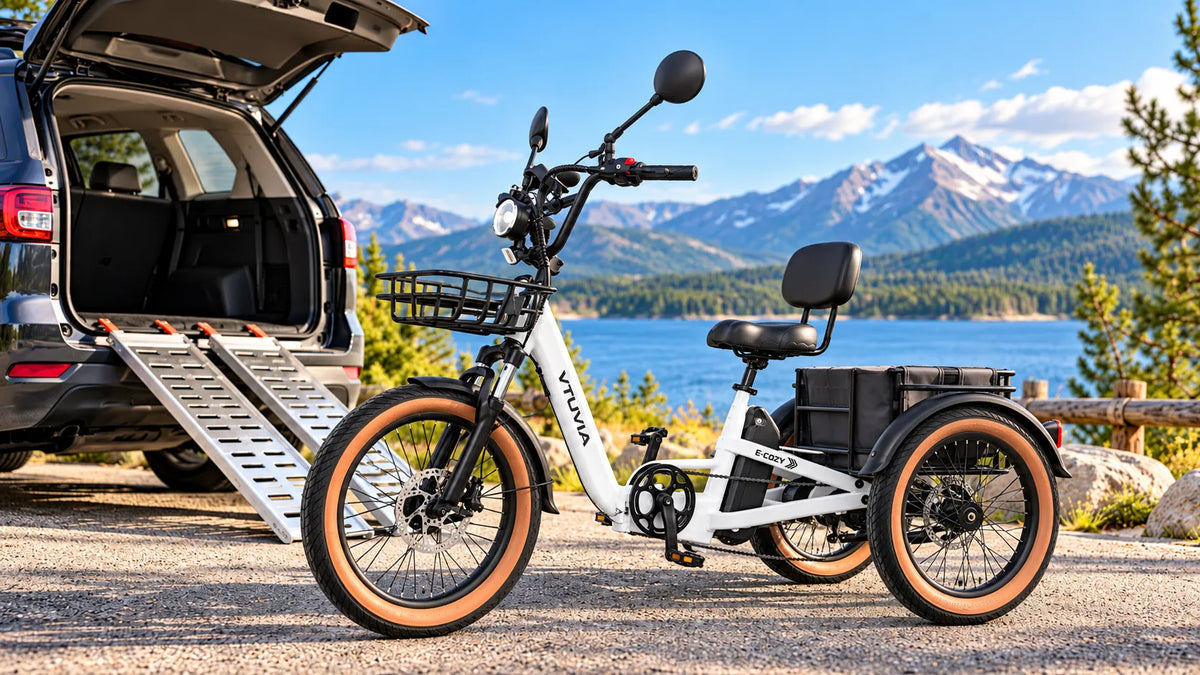


Share:
Is an Electric Trike Easier to Ride Than an E-Bike?
Electric Trike vs. Mobility Scooter: Which One Fits Your Lifestyle Better?