
One of the most common questions from first-time electric trike shoppers is simple: Do you actually have to pedal an electric trike?
For riders who are concerned about leg strength, fatigue, hills, or simply do not want every ride to feel like exercise, the answer can make a major difference in choosing the right trike.
Yes. Many electric trikes can be ridden without continuous pedaling if they are equipped with a throttle. A throttle sends power directly from the battery to the motor, allowing the trike to move without requiring the rider to keep turning the pedals.
However, throttle behavior, speed, range, and local riding rules can vary by model and location.
Table of Contents
- Do You Have to Pedal an Electric Trike?
- How Does Throttle Mode Work?
- Throttle vs Pedal Assist
- What Happens If You Get Tired During a Ride?
- Can Seniors Ride Without Pedaling?
- How Far Can You Ride Using Only the Throttle?
- When Is Throttle-Only Riding Useful?
- What Should You Look for If You Do Not Want to Pedal Much?
- How VTUVIA E-COZY Handles Low-Effort Riding
- Frequently Asked Questions
1. Do You Have to Pedal an Electric Trike?
Not necessarily.
Electric trikes usually provide motor assistance in one or both of two ways:
- Pedal assist
- Throttle control
With pedal assist, the rider pedals and the motor adds power. With a throttle, the rider can activate the motor directly without continuously pedaling.
That difference matters for riders who are concerned about fatigue, limited leg strength, joint discomfort, hills, or simply want more flexibility in how much effort they use.
A throttle-equipped electric trike allows you to pedal when you want to, reduce your effort when you become tired, or rely more heavily on the motor for part of the ride.
2. How Does Throttle Mode Work?
A throttle is usually located on the handlebar. When the rider activates it, the motor provides power without requiring the rider to pedal at the same time.
On some electric trikes, throttle response is variable. That means the amount of power depends on how much the rider twists or presses the throttle.
A light input can provide slower movement, while a larger input can provide stronger acceleration and higher speed.
This can be particularly useful when:
- starting from a complete stop
- leaving a parking space
- moving through a neighborhood
- navigating a driveway
- crossing a parking lot
- repositioning the trike in a tighter area
Important: A throttle should not always be thought of as “full speed or nothing.” A well-tuned variable throttle can also be useful for slow, controlled movement.
3. Throttle vs Pedal Assist: What Is the Difference?

| Feature | Throttle | Pedal Assist |
|---|---|---|
| Pedaling required | No | Yes |
| Motor activates | Through throttle input | When the rider pedals |
| Best for | Resting legs, starting, low-effort riding | Natural assisted cycling |
| Rider effort | Very low | Adjustable |
| Battery use | Can be higher | Often more efficient |
| Riding feel | More motor-driven | More bicycle-like |
Pedal assist is often better for riders who still want to stay active. The motor reduces effort, but the rider continues moving their legs.
Throttle mode is useful when the rider wants to reduce or temporarily stop pedaling. For many riders, having both is the most flexible setup.
4. What Happens If You Get Tired During a Ride?
This is one of the situations where throttle assistance becomes especially practical.

A Real-Life Example
Imagine riding several miles through your neighborhood or to a grocery store. The trip out feels easy, but on the way home your legs begin to feel tired.
On a traditional bicycle, you still need to pedal all the way home.
On a throttle-equipped electric trike, you can reduce your pedaling effort or stop pedaling temporarily and allow the motor to do more of the work.
That flexibility can make longer rides feel less intimidating, especially for older adults, returning riders, and people who do not want to worry about whether they will have enough energy for the return trip. If you are still learning how three-wheel riding differs from a traditional bike, visit our Complete Electric Trike Guide.
5. Can Seniors Ride an Electric Trike Without Pedaling?
Yes, if the electric trike includes throttle functionality.
This can be especially useful for older adults who want to stay active but do not want every ride to depend entirely on leg strength.
Some riders may pedal for most of the trip. Others may prefer a higher level of pedal assistance. Some may use the throttle more frequently.
There is no single correct way to ride an electric trike. The important part is having multiple ways to manage effort.
For seniors and older adults, useful low-effort riding features can include:
- throttle control
- torque-sensing pedal assist
- low step-through frame
- supportive seat and backrest
- hydraulic brakes
- stable three-wheel geometry
- reverse assist
- easy-to-reach controls
6. How Far Can You Ride Using Only the Throttle?
Throttle-only range is usually lower than pedal-assist range because the motor is doing more of the work.
Actual range depends on battery capacity, rider weight, cargo weight, hills, wind, tire pressure, riding speed, temperature, and how aggressively the throttle is used.
For example, the VTUVIA E-COZY advertises up to 70 miles with pedal assist and up to 40 miles using throttle, depending on riding conditions.
If maximum range is your priority, pedal assist is usually the better choice. If reducing physical effort is more important, throttle mode gives you another option.
7. When Is Throttle-Only Riding Useful?
Starting From a Stop
Electric trikes are heavier than traditional bicycles. Throttle assistance can make it easier to begin moving without needing a strong first pedal stroke.
After a Long Ride
If your legs feel tired after several miles, throttle assistance can help reduce the effort required to finish the trip.
Grocery Trips
A trike carrying groceries or other cargo may feel heavier when starting. Motor assistance can make the return trip easier.
Small Hills
Some riders prefer additional motor support on an incline instead of increasing their own pedaling effort.
Busy Parking Areas
Controlled low-speed throttle input can help move the trike around obstacles or through parking areas.
Returning to Cycling
Riders who have not ridden in years may feel more confident knowing they do not have to rely entirely on pedaling.
8. What Should You Look for If You Do Not Want to Pedal Much?
1. Variable Throttle Control
A throttle that responds progressively to rider input can make low-speed riding easier to control. You should be able to use a small amount of throttle without immediately jumping to maximum speed.
2. Enough Battery Range
If you plan to use the throttle frequently, pay attention to the manufacturer's throttle-range estimate rather than only the maximum pedal-assist range.
3. Comfortable Riding Position
If you are relying more heavily on the motor, you may spend long periods sitting in one position. Seat support, backrest position, handlebar reach, and leg angle become especially important.
4. Good Braking
Electric trikes are heavier than regular bicycles. Hydraulic brakes can provide controlled stopping with relatively low hand effort.
5. Stable Low-Speed Handling
Throttle power is most useful when the trike still feels predictable at low speed. Look for three-wheel stability, a rear differential, wide tires, appropriate wheelbase, and smooth controller tuning.
6. Reverse Assist
Reverse may not seem directly related to throttle riding, but it becomes important once you stop. A full-size trike can be difficult to manually pull backward out of a garage or tight parking area.
9. How VTUVIA E-COZY Handles Low-Effort Riding

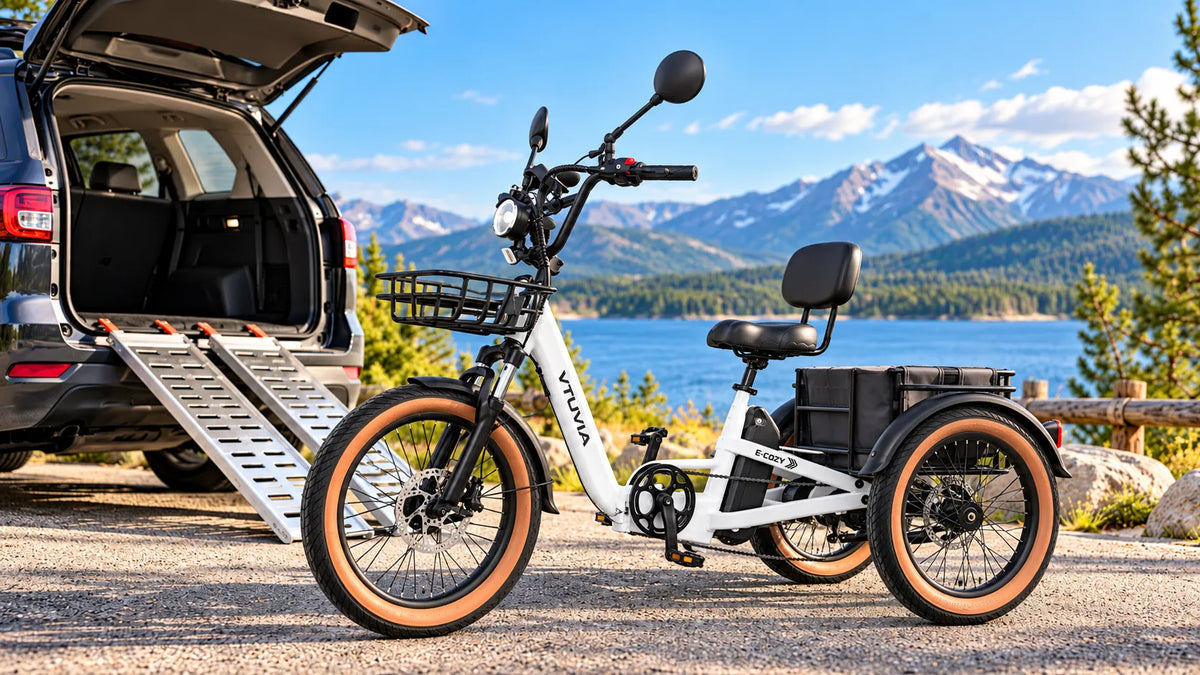
The VTUVIA E-COZY is designed around the idea that riders should be able to choose how much physical effort they want to use.
It combines:
- throttle control
- V-Adapt™ torque-sensing pedal assist
- reverse mode
- 750W motor
- up to 85Nm of torque
- hydraulic disc brakes
- rear differential
- 20 × 3.0-inch tires
- relaxed semi-recumbent-style riding position
Variable Throttle Control
E-COZY's throttle speed depends on how far the rider twists the throttle. A lighter twist can be used for slower movement, while continuing to twist the throttle increases motor output.
Maximum speed is up to 20 mph.
This gives the rider direct control over how much assistance they receive instead of treating the throttle as a simple on/off switch.
Pedal When You Want To
For riders who still want some exercise, the torque sensor res

ponds to pedaling effort and adds motor support accordingly.
You might pedal comfortably through a park, use more assistance on the way home, and rely on the throttle temporarily when your legs need a break.
Reverse When You Need It
E-COZY also includes reverse assist, useful for backing out of a garage, leaving a tight parking spot, moving away from a wall, or repositioning in a driveway.
VTUVIA E-COZY Electric Trike
Comfort, safety, and flexible motor assistance for everyday riding.

10. A Real-Life Example: Grocery Shopping Without Worrying About the Ride Home
Imagine your grocery store is three miles from home.
On the way there, you use pedal assist and pedal at a comfortable pace. Then you load your groceries into the rear cargo area.
By the time you start riding home, the trike is carrying more weight and your legs are already somewhat tired.
Instead of forcing yourself to pedal the entire way back, you can increase motor assistance or use the throttle when needed.
You are still able to ride independently, but the amount of physical effort does not have to remain the same for the entire trip.
11. Is Throttle Riding Better Than Pedal Assist?
Neither is universally better. They solve different problems.
| Choose Pedal Assist When You Want... | Use Throttle When You Want... |
|---|---|
| More physical activity | Less physical effort |
| Longer battery range | Help starting from a stop |
| A more bicycle-like feel | A temporary break from pedaling |
| Motor support that responds to pedaling | Easier short-distance maneuvering |
Final Thoughts
So, can you ride an electric trike without pedaling?
Yes—if the trike has a throttle.
But the real benefit is not simply being able to avoid pedaling. It is having more control over how much effort each ride requires.
You can pedal when you want exercise, use pedal assist when you want a lighter ride, and use the throttle when you need more help.
Explore VTUVIA E-COZY
Throttle control, torque-sensing pedal assist, reverse mode, relaxed seating, hydraulic brakes, and three-wheel stability—all designed to give riders more flexibility in how they ride. Prefer to try one first? Find a VTUVIA test ride location.
Explore VTUVIA E-COZYFrequently Asked Questions
Do you have to pedal an electric trike?
No. If the electric trike includes a throttle, it may be able to move without continuous pedaling.
Can seniors ride an electric trike without pedaling?
Yes. A throttle-equipped electric trike can allow older adults to reduce or temporarily stop pedaling while continuing to receive motor assistance.
Can you use an electric trike with throttle only?
Many throttle-equipped electric trikes can be ridden using the throttle without continuous pedaling.
Does using the throttle reduce range?
Usually, yes. Throttle-only riding generally uses more battery because the motor is doing more of the work.
How far can an electric trike go without pedaling?
It depends on the model and conditions. VTUVIA E-COZY advertises up to 40 miles of throttle range under suitable conditions.
Is a throttle useful for seniors?
It can be. A throttle can help with starting from a stop, reducing physical effort, finishing a ride when tired, and navigating short low-speed situations.
Share:
How to Choose the Right Electric Trike: A Practical Buyer's Guide
How to Stay Active After 60: Walking, Cycling and Easier Ways to Get Outdoors