
Comfort on an electric trike is about much more than having a wide seat.
A trike can look comfortable in photos and still feel awkward once you start riding. The handlebars may be too far away. The pedals may feel cramped. Getting on may require lifting your leg higher than expected. Or the motor may engage more abruptly than you'd like.
A truly comfortable electric trike should make the entire riding experience feel easier—from the moment you step onto the trike to the way you sit, pedal, steer, and ride over everyday roads.
That's the philosophy behind VTUVIA E-COZY.
Rather than treating comfort as a single feature, E-COZY combines an ultra-low step-through frame, adjustable supportive seating, relaxed riding geometry, torque-sensing assistance, suspension, and wider tires into one comfort-focused system.
So what should you actually look for when comparing comfortable electric trikes? If you're still learning how electric trikes work and which features matter most, our Complete Electric Trike Guide offers a broader introduction to electric trikes and guidance on choosing one.
Let's break down what really creates a comfortable ride.
Quick Answer: What Makes an Electric Trike Comfortable?
The most comfortable electric trikes combine several features rather than relying on one oversized saddle.
Look for:
- A low step-through frame for easier mounting and dismounting
- A wide, supportive seat
- A supportive backrest
- Adjustable seating and handlebar positions
- Relaxed riding geometry
- Smooth torque-sensing pedal assistance
- Front suspension
- Wider tires that help absorb everyday road imperfections
- Stable three-wheel handling
- Controls that feel predictable at low speeds
The important part is how these features work together.
A comfortable seat won't help much if you have to stretch toward the handlebars.
Likewise, wider tires won't solve an awkward riding position.
Real comfort comes from the complete riding system.
For more information about seating, riding position, suspension, and other comfort-focused features, explore our Electric Trike Comfort Guides.
Table of Contents
- 1. Easy Comfort Starts Before You Even Sit Down
- 2. The Seat Should Support You, Not Just Feel Soft
- 3. A Backrest Changes the Way You Sit
- 4. Your Seat, Backrest, Handlebars and Pedals Must Work Together
- 5. A Relaxed Pedaling Position Can Change the Entire Ride
- 6. Smooth Power Delivery Is Part of Comfort Too
- 7. Suspension Helps Isolate You From Everyday Road Imperfections
- 8. Wider Tires Add Another Layer of Ride Comfort
- 9. Stability Is Part of Feeling Comfortable
- 10. Braking Should Feel Predictable, Not Intimidating
- 11. Comfort Should Continue Into Everyday Life
- 12. What Should You Look for When Test Riding a Comfortable Electric Trike?
- Why E-COZY Was Designed Around Comfort
- Who Is a Comfort-Focused Electric Trike For?
- Frequently Asked Questions
1. Easy Comfort Starts Before You Even Sit Down
One of the most overlooked parts of electric trike comfort happens before the ride begins:
Getting on and off.
Traditional bicycles and some electric trikes have relatively high frame sections that require the rider to lift one leg over the bike.
For younger or more flexible riders, this may not seem important.
For older adults, riders with limited flexibility, or anyone who simply wants an easier everyday experience, it can make a major difference.
That's why a low step-through electric trike can feel more approachable.
E-COZY uses a 14.8-inch ultra-low step-through frame, allowing riders to step through the center rather than swinging a leg over a high top tube.
This becomes especially useful during everyday riding when you may get on and off repeatedly—for example:
- Grocery trips
- Neighborhood errands
- Park visits
- Coffee stops
- Community rides
Comfort isn't only about what happens while you're moving.
It starts with how easily you can get into the riding position.
2. The Seat Should Support You, Not Just Feel Soft
A large saddle is one of the easiest features to market as "comfortable."
But size alone doesn't determine comfort.
A good electric trike seat needs to provide enough support while still allowing the rider's legs to move naturally through the pedal stroke.
If a saddle is too narrow, some riders may not feel adequately supported.
If it's excessively wide or poorly positioned, it can interfere with natural pedaling.
E-COZY uses a wide, cushioned comfort saddle designed around relaxed everyday riding rather than a narrow performance-oriented bicycle position.
But the saddle is only one part of the seating system.
What happens behind the rider matters too.
3. A Backrest Changes the Way You Sit
Most conventional bicycles expect the rider to support their upper body while leaning toward the handlebars.
A comfort-oriented electric trike can take a different approach.
A supportive backrest provides another contact point behind the rider, making it possible to settle into a more relaxed, upright riding position during casual cruising.
That's why E-COZY pairs its comfort saddle with an adjustable supportive backrest.
Rather than treating the backrest as a decorative accessory, its position is part of the overall seating geometry.
Different riders have different heights, torso lengths, and preferred positions, so adjustability helps riders find a setup that feels more natural.
This becomes particularly noticeable as rides get longer.
The question isn't simply:
"Does this electric trike have a big seat?"
A better question is:
"Will this seating position still feel comfortable after I've been riding for a while?"
4. Your Seat, Backrest, Handlebars and Pedals Must Work Together
This is where many discussions about electric trike comfort stop too early.
Imagine sitting against a comfortable backrest—but having to lean away from it every time you reach for the handlebars.
The backrest would immediately become less useful.
That's why riding geometry matters.
On a well-designed, comfortable electric trike, four important contact points should work together:
Seat
Establishes your main riding position and supports your body.
Backrest
Provides support behind you during relaxed riding.
Handlebars
Should be within a comfortable reach without requiring excessive forward leaning.
Pedals
Should allow your legs to move naturally without making the riding position feel cramped.
E-COZY was designed around this relationship.
Its adjustable seat position and stem give riders greater flexibility to find a natural relationship among the saddle, backrest, handlebars, and pedals.
Instead of forcing every rider into one fixed position, the goal is to make the riding position adapt more naturally to the person.
That's a much better way to think about electric trike comfort than simply comparing saddle dimensions.
5. A Relaxed Pedaling Position Can Change the Entire Ride
Pedal position doesn't get nearly as much attention as motor power or battery size.
But it has a major influence on how a trike feels.
On a traditional bicycle, the pedals are generally positioned almost directly below the rider.
Comfort-oriented trikes can use a more relaxed forward pedal position that allows the legs to extend more naturally during the pedal stroke.
The goal isn't to create a fully recumbent riding position.
Instead, the rider remains upright while the relationship between the seat and pedals creates a less cramped feeling.
This works particularly well when combined with a supportive backrest.
Rather than constantly shifting your upper body forward, you can maintain a more relaxed seating position while pedaling.
For riders comparing an electric trike for seniors or simply looking for a less athletic riding posture, pedal geometry deserves far more attention than it usually receives.
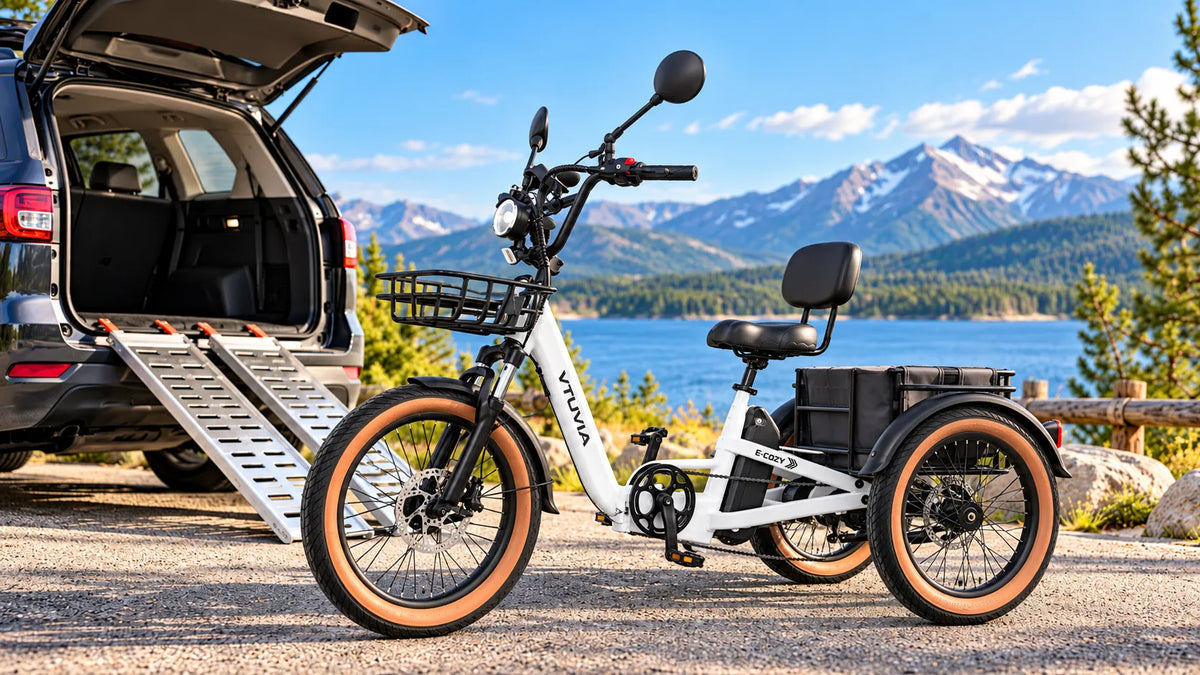
VTUVIA E-COZY Electric Trike
Designed for a more comfortable, supported everyday ride.

6. Smooth Power Delivery Is Part of Comfort Too
Comfort isn't purely physical.
It's also about how predictable the trike feels when you start moving.
Some electric bikes use cadence sensors that detect whether the pedals are turning and then activate a preset level of motor assistance.
A torque sensor works differently.
It detects how much force the rider applies to the pedals and adjusts motor assistance proportionally.
Pedal gently, and the assistance comes in gently.
Push harder, and the motor provides more help.
E-COZY uses torque-sensing pedal assistance because predictable power delivery matters on a three-wheel platform—especially during:
- Starting from a stop
- Riding through parking areas
- Navigating neighborhood streets
- Making frequent stops during errands
- Riding at lower speeds
For comfort-focused riders, the best motor isn't necessarily the one that feels the most aggressive.
It's the one that feels natural and easy to control.
7. Suspension Helps Isolate You From Everyday Road Imperfections
Even the best seating position can feel uncomfortable if every crack and bump in the road reaches the rider.
That's where suspension becomes important.
E-COZY uses a 60 mm front suspension fork to help absorb impacts from uneven pavement and everyday road imperfections before they reach the handlebars and rider.
This is particularly relevant for the type of environments where electric trikes are often used:
- Residential streets
- Bike paths
- Park trails
- Parking lots
- Paved community routes
You don't need mountain-bike-level suspension for these environments.
The goal is simply to make ordinary surfaces feel smoother and less disruptive.
8. Wider Tires Add Another Layer of Ride Comfort
Suspension isn't working alone.
Tires are another important contact point between the trike and the road.
E-COZY uses 20 × 3.0-inch tires, giving the trike a wider footprint than a conventional bicycle tire.
The additional tire volume can help soften smaller road imperfections while contributing to the planted feel many riders expect from a comfort-oriented electric trike.
The 20-inch wheel size also helps keep the overall trike geometry relatively low.
This supports another important aspect of E-COZY's design:
Keeping the rider closer to the ground rather than creating an unnecessarily tall riding platform.
Again, no single component creates the entire comfort experience.
The tires, suspension, frame geometry, and seating position are working together.
9. Stability Is Part of Feeling Comfortable
Physical softness isn't the only kind of comfort.
There's also the comfort that comes from feeling predictable and composed on the trike.
Three wheels eliminate the need to balance the vehicle in the same way you would balance a traditional bicycle when stopped.
But three-wheel handling is different from two-wheel handling, particularly when turning.
This is why E-COZY uses a rear differential.
When a trike turns, the inside and outside rear wheels need to travel different distances.
A differential allows the rear wheels to rotate at different speeds through a corner, helping create smoother, more natural turning behavior.
This doesn't mean riders should take corners aggressively.
An electric trike should still be ridden at an appropriate speed, especially through turns.
But predictable handling is an important part of creating a ride that feels comfortable rather than demanding.
10. Braking Should Feel Predictable, Not Intimidating
You can't talk seriously about comfort without talking about stopping.
A rider who isn't confident about controlling speed will never feel completely relaxed.
E-COZY uses hydraulic disc braking with 180 mm rotors, designed to provide controlled stopping performance for a heavier three-wheel platform.
The trike also includes a parking function that helps keep it stationary when parked.
This matters during everyday situations such as:
- Loading groceries
- Getting on and off
- Stopping outside a store
- Parking on suitable surfaces
- Preparing for the next ride
Comfort isn't simply about adding more padding.
It's also about reducing the small moments of uncertainty that can make a vehicle feel difficult to use.
11. Comfort Should Continue Into Everyday Life
A comfortable electric trike shouldn't only feel good during a test ride.
It should make everyday activities easier to enjoy.
That's where cargo capacity and practical design become part of the equation.
E-COZY's rear cargo area gives riders room for everyday items such as:
- Grocery bags
- Picnic supplies
- Personal belongings
- Small packages
- Pet supplies
- Farmers market purchases
This changes what "comfort" means.
You're not carrying a backpack full of groceries on your shoulders.
You're not trying to balance shopping bags from the handlebars.
You're letting the trike carry the load while you focus on riding.
For many riders, that's the difference between a recreational toy and an electric trike for everyday riding.
12. What Should You Look for When Test Riding a Comfortable Electric Trike?
Specifications can help narrow your options, but comfort is personal.
Whenever possible, test the complete riding position rather than judging a trike from photos.
The most comfortable electric trike isn't necessarily the one with the longest feature list.
It's the one that requires the least effort from you to simply settle in and enjoy the ride.
Why E-COZY Was Designed Around Comfort
E-COZY wasn't designed around the question:
"How fast can we make an electric trike?"
It was designed around a different question:
"What would make someone actually want to ride it every day?"
That led to a different set of priorities.
A 14.8-inch ultra-low step-through makes getting on easier.
A wide comfort saddle and supportive adjustable backrest create a more relaxed seating environment.
An adjustable stem and seating position help accommodate different riders.
A torque sensor delivers assistance based on rider input.
A 60 mm suspension fork and 20 × 3.0-inch tires help smooth everyday surfaces.
A rear differential supports smoother cornering behavior.
And hydraulic braking provides controlled stopping for everyday riding.
None of these features alone makes E-COZY comfortable.
The way they work together does.
That's ultimately the difference between adding comfort features to an electric trike and designing an electric trike around comfort from the beginning.
Who Is a Comfort-Focused Electric Trike For?
A comfort-oriented electric trike can make sense for many different riders.
It may be particularly appealing if you:
- Prefer upright riding over an aggressive cycling posture
- Want three-wheel stability at stops
- Find high step-over frames inconvenient
- Want support behind your back while cruising
- Prefer smooth rather than aggressive motor assistance
- Plan to ride around your neighborhood or community
- Use your trike for groceries and everyday errands
- Want to spend more time outdoors without treating every ride like a workout
This includes many older riders, but comfort isn't exclusively about age.
You don't need to wait until cycling becomes difficult before deciding you'd rather ride something more comfortable.
Sometimes comfort simply makes riding more enjoyable.
Frequently Asked Questions
What is the most important comfort feature on an electric trike?
There isn't one single feature that determines comfort. Seat design, back support, handlebar reach, pedal position, frame access, suspension, tires, and power delivery all influence how the trike feels. The best comfort-focused designs treat these elements as one system.
Are electric trikes comfortable for seniors?
Many older adults prefer electric trikes because three wheels remove the need to balance the vehicle at a stop, while low step-through frames, upright seating, and supportive backrests can create a more approachable riding position. Individual fit and riding ability still matter, so a test ride is valuable whenever possible.
Is a backrest important on an electric trike?
For riders who prefer relaxed, upright riding, a backrest can provide useful additional support. However, the backrest works best when its position matches the seat, handlebars, and pedals rather than being treated as an isolated feature.
Is a low step-through electric trike easier to get on?
A lower step-through reduces how high the rider needs to lift a leg when mounting or dismounting. This can make repeated stops and everyday use more convenient, particularly for riders who prefer easier access.
Does a torque sensor make an electric trike more comfortable?
A torque sensor can contribute to a smoother riding experience because assistance responds proportionally to pedaling effort. For riders who value predictable power delivery, this can feel more natural than assistance that arrives at a fixed level.
Do wider tires make an electric trike more comfortable?
Wider tires generally provide more air volume and can help soften smaller road imperfections. However, tire pressure, suspension, wheel size, frame design, and seating also influence overall ride comfort.
What should I look for in a comfortable electric trike for seniors?
Prioritize easy step-through access, supportive and adjustable seating, natural handlebar reach, manageable controls, predictable braking and power delivery, appropriate three-wheel handling, and a riding position that fits the individual rider.
Final Thoughts
A comfortable electric trike isn't defined by the size of its saddle.
It's defined by how little the trike asks the rider to adapt.
Getting on should feel approachable.
Sitting should feel supported.
Reaching the controls should feel natural.
Pedaling should feel relaxed.
Motor assistance should feel predictable.
And everyday roads shouldn't constantly interrupt the experience.
That's the thinking behind E-COZY.
Instead of adding a few comfort features to a conventional trike, E-COZY brings together accessible frame geometry, supportive seating, adjustability, smooth power delivery, suspension, wider tires, and three-wheel handling into one comfort-focused riding system.
Because the goal isn't simply to make an electric trike easier to ride.
It's to make you want to keep riding.

Share:
Who Should Ride an Electric Trike?
Why We Built E-COZY: Rethinking What an Electric Trike Should Feel Like