
Electric Trike vs. Traditional Tricycle: Is Electric Assist Worth the Extra Cost?
Both offer the stability of three wheels. But for riders looking for a more comfortable way to keep riding, the difference between a traditional tricycle and an electric trike goes far beyond simply adding a motor.

Quick Answer: Electric Trike vs. Traditional Tricycle
For many riders, the decision to move from two wheels to three begins with two priorities: stability and comfort.
Some riders no longer feel as comfortable balancing a conventional bicycle. Others may have reduced flexibility, experience knee discomfort, or simply want a more supported and relaxed way to continue riding.
A traditional adult tricycle provides the fundamental stability of three wheels, but the rider still has to provide all of the propulsion when starting, climbing, riding farther, or carrying cargo.
An electric trike keeps the three-wheel foundation while adding motor assistance, helping reduce the amount of physical effort required during everyday riding.
A thoughtfully designed electric trike can go even further: making it easier to get on, creating a more relaxed riding posture, and delivering assistance in a way that feels natural.
That's the thinking behind VTUVIA E-COZY: not simply adding a motor to three wheels, but designing the entire riding experience around stability and comfort.
Why Do Riders Choose Three Wheels in the First Place?
For many people considering an adult trike, speed isn't the first priority.
The first question is often much more personal:
Some riders are returning to cycling after years away.
Others may have reduced flexibility, experience knee discomfort, or simply no longer feel comfortable balancing on two wheels, particularly while starting, stopping, or riding slowly.
This is where the three-wheel platform becomes valuable.
Unlike a conventional bicycle, a trike doesn't require the rider to continuously balance the vehicle in the same way while riding slowly or stopped.
For many riders, choosing a trike begins with two needs:
A riding experience that feels more stable and more comfortable.

Electric Trike vs Traditional Tricycle at a Glance
Both provide the foundation of three-wheel riding. The biggest differences appear when you start thinking about physical effort, distance, cargo, hills, and long-term comfort.
| What Matters | Traditional Adult Tricycle | Electric Trike |
|---|---|---|
| Three-Wheel Stability | Yes | Yes |
| Motor Assistance | No | Yes |
| Starting From a Stop | Full rider effort | Motor can assist |
| Hills | More physically demanding | The motor helps reduce rider effort |
| Longer Rides | Effort builds over time. | Assistance helps manage effort |
| Carrying Cargo | Rider moves all added weight | Motor helps share the workload |
| Step-Through Access | Depends heavily on frame design | Can be designed with ultra-low access |
| Riding Comfort | Depends on frame and seat geometry | Can combine ergonomic geometry with electric assistance |
| Charging | Not required | Required |
| Purchase Price | Usually lower | Usually higher |
| Best Fit | Short, flat recreational rides | Frequent rides, errands, cargo, hills and longer trips |
1. The Biggest Difference: Who Provides the Power?
On a traditional tricycle, every bit of forward movement ultimately comes from the rider.
For a short ride on smooth, flat pavement, that may be completely manageable.
But real-world riding isn't always flat.
You leave home. Stop at an intersection. Start again. Ride into a headwind. Climb a slight incline. Stop at the grocery store. Put several bags into the basket. Then ride home.
Every one of those situations asks the rider to contribute more energy.
Electric trike: you pedal while the motor helps share the workload.
E-COZY uses a 750W rear motor with up to 85Nm of torque.
But the point isn't simply having a larger motor number.
The power is there for the situations where riders may appreciate help most: starting, climbing, riding farther, or carrying everyday cargo.
2. Why Can a Traditional Tricycle Feel Tiring Over Time?
A traditional adult tricycle may feel easy enough during the first part of a flat ride.
But an adult trike is a larger riding system than a conventional bicycle.
Add the weight of the trike, the rider, cargo equipment, groceries, repeated stops, hills, or headwinds, and the rider still has to provide all of the energy needed to keep everything moving.
That means the first mile can feel very different from the fifth or tenth mile.
The biggest advantage of electric assistance isn't simply going faster.
It's helping make riding feel manageable for longer.
This matters for riders who still want to pedal and stay active, but don't necessarily want every neighborhood trip or grocery run to become a demanding workout.
3. Starting Can Matter More Than Top Speed
Once a trike is rolling on level ground, maintaining momentum may feel relatively easy.
Getting the trike moving from a complete stop is different.
Starts can become more demanding when:
- The basket is loaded.
- The road slopes upward.
- The rider has already been riding for a while.
- The rider prefers not to push hard through the pedals.
During a normal neighborhood ride, you may start and stop many times.
This is why useful electric assistance is about more than top speed.
It's about helping during the moments when the rider actually needs it.
4. Cargo Changes the Ride More Than Many Riders Expect
Cargo capacity is another major reason people choose an adult trike.
A large basket can turn a recreational bicycle into practical everyday transportation.
Groceries
Food, drinks, household supplies, and weekly purchases quickly add meaningful weight.
Daily Errands
Farmers market purchases, picnic supplies, gardening items, and personal belongings all add to the load.
The Ride Home
The question isn't only whether the basket can carry the load. It's how that weight affects the ride home.

A traditional tricycle can certainly carry cargo.
But every additional pound still has to be moved by the rider.
An electric trike doesn't make the weight disappear, but motor assistance helps reduce how much of the added workload must come from the rider's legs.
E-COZY is designed for practical everyday use with an integrated heavy-duty rear rack and up to 450 lbs total payload capacity.
For someone planning grocery trips or everyday errands, the question isn't just:
“Can the trike carry this?”
It's also: “Will I still feel comfortable riding home with it?”
5. Comfort Starts Before You Even Begin Pedaling
When people compare trikes, motor power usually gets most of the attention.
But for riders choosing three wheels because balance, flexibility, or comfort has become more important, one of the most meaningful differences appears before the motor even turns on:

14.8" Ultra-Low Step-Through
Traditional adult tricycles vary considerably in frame design.
Some still require the rider to lift a leg relatively high before getting seated.
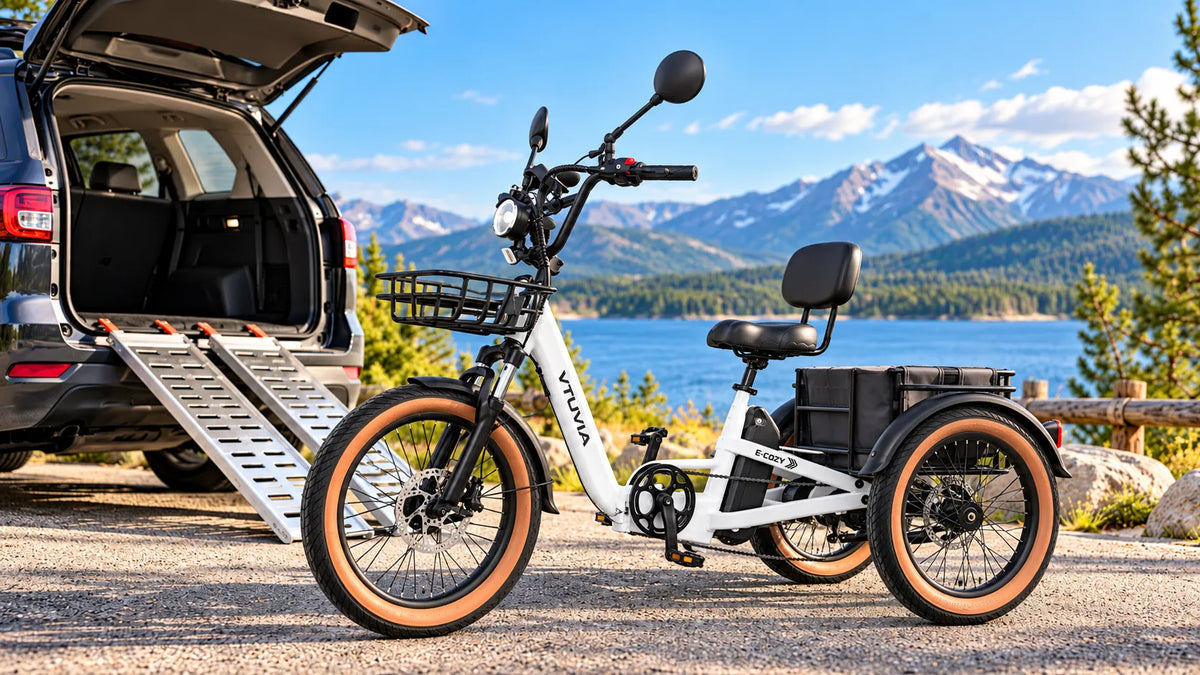
E-COZY uses a 14.8-inch ultra-low step-through frame designed to reduce unnecessary leg lifting and make getting on and off easier.
Step through → sit down → ride.
For riders with reduced flexibility, knee discomfort, or anyone who simply prefers easier access, this can be an important part of everyday comfort.
If someone chooses three wheels because they want riding to feel easier and more approachable, the frame should support that goal from the moment they get onto the trike.
6. Pedal Position Can Change the Entire Riding Experience
Easy access solves one part of the problem.
The next question is:
How does your body feel after you've been riding for 20 or 30 minutes?
Traditional bicycle geometry usually places the pedals more directly beneath the rider.
That works very well for conventional bicycle riding, where riders may shift position, lean forward, or occasionally rise from the saddle.
Many trike riders are looking for something different: a more relaxed, fully seated riding position with additional support.

ComfortFit™ Forward-Pedaling Geometry
E-COZY moves the pedaling position farther forward and combines it with an adjustable saddle and supportive backrest.
This allows the legs to extend slightly ahead of the hips while the upper body remains supported.
Instead of asking the rider to adapt to a conventional cycling posture, E-COZY is designed around the relaxed, seated style of riding many trike owners actually want.
For someone choosing a trike because comfort matters as much as stability, this can be just as important as the motor itself.
Learn more in our Forward-Pedaling Electric Trike Guide .
7. Electric Assistance Should Feel Natural
More power doesn't automatically mean more comfort.
The way that power is delivered matters.
If assistance arrives too suddenly, the ride can feel disconnected.
If assistance is too weak or delayed, the rider may still feel like they're doing most of the work.
V-Adapt™ Riding System
E-COZY uses VTUVIA's tuned V-Adapt™ Riding System, combining rider input with torque-sensing pedal assistance and tuned controller response.
Pedal Lightly
Assistance remains gentle while the rider cruises comfortably.
Apply More Effort
The system responds with additional support as rider input increases.
Ride Naturally
The goal is smooth, predictable assistance rather than a sudden burst of motor power.
A basic electric trike adds motor power.
E-COZY is designed so rider and motor work together naturally.
8. Three Wheels Are the Foundation of Stability— Not the Whole Story
Both a traditional tricycle and an electric trike benefit from a three-wheel platform.
But how stable and planted a trike feels also depends on the way the rest of the vehicle is designed.
E-COZY combines:
- 20 × 3.0" tires for a balanced everyday footprint
- Rear differential to support smoother turning behavior
- Balanced frame geometry designed around predictable everyday handling
- 14.8" ultra-low step-through for easier rider access
The point isn't that a traditional adult tricycle cannot be stable.
The point is that once stability is already one of the reasons you're choosing three wheels, it makes sense to evaluate how the entire trike has been designed around that priority.
Why E-COZY Is More Than a Traditional Tricycle With a Motor
If the only difference between a traditional tricycle and an electric trike were the motor, choosing between them would be simple.
E-COZY was designed around a broader question:
If a rider chooses three wheels because stability and comfort matter, how should the entire trike be designed around those needs?
E-COZY's advantage isn't one individual specification.
It's how the design works together.
Three wheels provide the foundation for stability.
The ultra-low frame makes the trike easier to approach.
Forward-pedaling geometry supports a more relaxed riding position.
V-Adapt™ electric assistance helps reduce the physical effort required during everyday riding.
Traditional Tricycle or Electric Trike: Which One Is Right for You?
Electric assistance doesn't automatically make sense for every rider.
The right decision depends on how you realistically expect to use your trike.
A Traditional Adult Tricycle May Be Enough If...
- Your rides are short.
- Your routes are mostly flat.
- You are comfortable providing all of the pedaling effort yourself.
- You rarely carry substantial cargo.
- You mainly ride recreationally close to home.
- You want a lower initial purchase price.
- You prefer a simpler bicycle without a battery or electric system.
An Electric Trike May Be Worth It If...
- You want the stability of three wheels with less physical effort.
- You experience reduced endurance or prefer a more manageable ride.
- Your routes include hills or frequent starts and stops.
- You regularly carry groceries or everyday cargo.
- You want to use your trike for practical transportation.
- Comfort becomes more important the longer you ride.
- You want a trike you'll realistically feel comfortable using often.
Don't Choose an Electric Trike by Motor and Battery Size Alone
Once riders decide they want electric assistance, it's easy to compare nothing but numbers.
750W vs 1000W. 15Ah vs 20Ah. 60 miles vs 80 miles.
Those numbers matter.
But they don't tell you whether you'll actually feel comfortable using the trike every day.
Can I Get On Easily?
Look at step-through height and how much leg movement is required before you even begin riding.
How Do I Sit?
Back support, pedal location, handlebar reach, and seat adjustment all influence longer-ride comfort.
How Does the Motor Feel?
Smooth and predictable assistance may matter more than simply choosing the largest wattage number.
What Will I Carry?
Grocery and everyday cargo use changes how much effort the entire ride requires.
How Far Will I Really Ride?
Choose range around your real lifestyle rather than automatically choosing the largest battery.
Will I Want to Ride It Again Tomorrow?
The best trike isn't the one with the largest specification sheet. It's the one that fits your body and your everyday life.
Electric Trike vs Traditional Tricycle: The Bottom Line
Traditional adult tricycles still make sense for some riders.
They're simpler, usually less expensive, and can provide the stability of three wheels for short and relatively flat recreational rides.
But many people looking for a trike aren't simply looking for three wheels.
They're looking for a way to keep riding when balancing a conventional bicycle no longer feels comfortable, when flexibility has changed, when longer rides require more energy than before, or when they simply want a more relaxed riding experience.
That's where electric assistance begins to justify the additional cost.
Electric assistance reduces the effort.
Thoughtful geometry makes the ride more comfortable.
For someone who only wants occasional short rides, a traditional tricycle may be enough.
For someone who wants to ride farther, carry groceries, handle more varied terrain, and continue riding comfortably, a thoughtfully designed electric trike can offer a very different everyday experience.
And if comfort is one of the main reasons you're choosing three wheels, don't evaluate the motor alone.
Look at the entire riding system: how easily you step through the frame, how your body is supported, where your feet naturally sit, and how smoothly the motor responds to you.
Frequently Asked Questions
Why do many riders choose a three-wheel bike?
Many riders choose a trike because they want greater stability and a more supported riding experience than a conventional two-wheel bicycle. This can be especially useful for riders who are less comfortable balancing at low speeds or who prefer a more relaxed riding position.
Is an electric trike easier to pedal than a traditional tricycle?
Electric assistance helps reduce how much propulsion must come from the rider alone. The difference can become especially noticeable when starting, climbing hills, riding longer distances, or carrying cargo.
Is an electric trike worth the extra cost?
It depends on how you ride. For short and flat recreational rides, a traditional tricycle may be sufficient. For frequent errands, cargo trips, hills, longer rides, or riders who want to reduce physical effort, electric assistance can make the trike more usable in everyday life.
Why is step-through height important on an adult trike?
A lower step-through reduces how high the rider has to lift a leg when getting on and off. This can be particularly useful for riders with reduced flexibility or anyone who values easier access.
What is the step-through height of the VTUVIA E-COZY?
E-COZY uses a 14.8-inch ultra-low step-through frame designed to make getting on and off simpler and more approachable.
Why does E-COZY place the pedals farther forward?
E-COZY's ComfortFit™ Forward-Pedaling Geometry positions the pedals farther ahead than a traditional upright bicycle layout. Combined with the adjustable saddle and supportive backrest, it creates a more relaxed seated riding position.
Does a bigger motor always mean a better electric trike?
No. Motor output is only one part of the riding experience. Frame access, riding geometry, motor response, seat support, cargo needs, range, and overall comfort can matter just as much.
Can you still exercise while riding an electric trike?
Yes. Pedal-assist systems still allow the rider to pedal and contribute effort. Electric assistance simply provides additional support based on terrain, distance, cargo, and the rider's preferred effort level.
The Best Trike Is the One You'll Feel Comfortable Riding Again and Again
The reason to choose an electric trike isn't simply that it has a motor.
It's that electric assistance can remove some of the effort that makes starts, longer rides, hills, and cargo trips more demanding on a traditional tricycle.
E-COZY takes that idea further by combining electric support with a 14.8" ultra-low step-through frame, ComfortFit™ forward-pedaling geometry, supportive seating, and the V-Adapt™ Riding System.
The goal isn't simply to make a traditional tricycle faster.
It's to make three-wheel riding feel more stable, more comfortable, and easier to enjoy as part of everyday life.
Explore the VTUVIA E-COZY.
Share:
Reverse Mode: A Small Feature That Makes a Big Difference.
Best Electric Trike for Seniors (2026)