
If you're trying to figure out how to choose an electric trike, the number of specifications can make the decision feel more complicated than it needs to be.
At first, many electric trikes look similar: three wheels, a motor, a battery, a seat, and some cargo space. But once you start comparing them, differences in frame geometry, seating, assistance, braking, turning, storage, and fit can have a much bigger impact on everyday riding than a single headline specification.
That's why a useful electric trike buying guide shouldn't begin with the biggest motor or longest range.
It should begin with how you actually plan to ride.
Quick Answer: To choose the right electric trike, first identify your top three to five needs. Then compare step-through height, riding position, stability-related geometry, motor assistance, sensor type, brakes, turning design, cargo, range, storage, fit, and support against those priorities.
The right electric trike isn't necessarily the one with the longest feature list.
It's the one whose design best matches the rides you actually want to take.
If you're still learning the basics, start with our Complete Electric Trike Guide before comparing individual models.
Table of Contents
- 1. Start With How You'll Actually Use Your Electric Trike
- 2. Compare Electric Trike Stability Beyond Three Wheels
- 3. Check Electric Trike Step-Through Height
- 4. Choose a Comfortable Riding Position
- 5. Decide How Much Pedaling You Want to Do
- 6. Compare Motors and Pedal-Assist Sensors
- 7. Consider Turning and the Rear Differential
- 8. Compare Brakes and Parking Features
- 9. Match Tires and Suspension to Your Roads
- 10. Choose the Right Cargo Capacity
- 11. Decide Whether Reverse Assist Matters
- 12. Measure Before Buying a Folding Electric Trike
- 13. Compare Realistic Electric Trike Range
- 14. Check Rider Fit, Capacity, Service, and Support
- 15. Build Your Electric Trike Shortlist
- Where Does E-COZY Fit?
- Electric Trike Buying FAQ
1. Start With How You'll Actually Use Your Electric Trike
Before comparing motors, batteries, or technical specifications, answer a simpler question:
What do you want your electric trike to help you do?
Your answer changes what you should prioritize.
Neighborhood Riding
If most rides will be around your neighborhood or community, comfortable seating, predictable low-speed assistance, easy mounting, and approachable handling may matter more than extreme range.
Grocery Runs & Everyday Errands
Cargo capacity becomes more important. So do braking, parking, motor assistance, and the ability to maneuver a loaded trike.
Longer Recreational Rides
Riding position, back support, suspension, tire size, battery capacity, and overall comfort become more noticeable as time in the saddle increases.
RV & Travel Use
Folding design, actual folded dimensions, total trike weight, and how you'll transport it may matter more than a few extra miles of advertised range.
If reducing physical effort is one of the main reasons you're considering an electric trike, pay closer attention to motor assistance, throttle availability, torque, pedal sensing, and how naturally that assistance is delivered.
There is no universally best electric trike. There is a best match for a particular rider and use case.
2. Compare Electric Trike Stability Beyond Three Wheels
It's easy to assume that all electric trikes feel equally stable because they all have three wheels.
But wheel count is only part of the equation.
Electric trike stability and handling can also be influenced by:
- Center of gravity
- Overall width
- Wheelbase
- Seat height
- Rider position
- Weight distribution
- Tire size
- Cornering design
A relatively tall riding position on a narrower platform can feel very different from a lower rider position on a broader platform.
So don't stop at "Does it have three wheels?"
Ask: "Where does the rider sit relative to those three wheels?"
No trike design removes the need to slow appropriately before cornering.
3. Check Electric Trike Step-Through Height
Step-through height is one of the easiest specifications to overlook when shopping for an electric trike online—and one of the easiest to notice once you own it.
A frame may be described as "step-through," "low-step," or "easy access," but those labels don't tell you the actual height you need to clear.
For example, E-COZY uses a 14.8-inch ultra-low step-through, reducing how high the rider needs to lift a leg when getting on.
When comparing electric trikes, look for the actual measured step-through height rather than relying only on terms like "low-step." Two trikes using the same description can require very different amounts of leg lift.
4. Choose a Comfortable Electric Trike Riding Position, Not Just a Seat
A wide padded saddle may look comfortable in a product photo, but choosing a comfortable electric trike involves more than seat size.
Your relationship with the seat, backrest, handlebars, and pedals determines how your body is positioned throughout the ride.
Ask:
- Does the seat support the way I want to sit?
- Is there a backrest?
- Can the seating position be adjusted?
- Can the handlebar reach be adjusted?
- Do I have to lean forward to reach the controls?
- Where do my feet sit relative to my hips?
- Can different rider heights find a comfortable position?
If back support is one of your priorities, our guide to Why a Backrest Matters on an Electric Trike explains why the complete riding position matters more than saddle size alone.
Don't choose the biggest seat. Choose the riding position that makes sense for your body.
5. Decide How Much Pedaling You Want to Do
One of the most useful questions when choosing an electric trike is also one of the simplest:
How much do you actually want to pedal?
Some riders still enjoy pedaling but want assistance on hills. Others prefer light pedaling. Some want the option to move without relying heavily on pedaling at all.
When comparing models, check for:
- Pedal assist
- Multiple assistance levels
- Throttle operation
- Adequate torque for your terrain and load
- Controls that are comfortable for you to operate
Motor power matters, but more power isn't automatically the better choice.
Does the assistance match the way you want to ride?
6. Compare Electric Trike Motors and Pedal-Assist Sensors
Motor wattage gets a lot of attention when people compare electric trikes. The pedal-assist sensor often gets much less.
Cadence Sensor
A cadence sensor generally detects whether the pedals are rotating and provides assistance according to the selected level.
Torque Sensor
A torque sensor responds to how much force you're applying to the pedals.
Push harder and the system can provide more assistance. Pedal gently and assistance can remain gentler.
E-COZY uses a torque sensor as part of its focus on controlled, comfortable everyday riding.
Don't only ask "How powerful is it?"
Also ask "How does that power arrive?"
7. Consider Electric Trike Turning and the Rear Differential
When a trike turns, the outside rear wheel travels farther than the inside rear wheel.
A rear differential allows the two rear wheels to rotate at different speeds during that turn.
E-COZY includes a rear differential as part of its three-wheel handling system.
For a closer look, see Electric Trike vs. Traditional Trike: What's the Difference? .
A differential doesn't mean you should corner quickly. It means the drivetrain itself is designed to account for the different paths the rear wheels take through a turn.
8. Compare Electric Trike Brakes and Parking Features
Electric trikes can be substantial vehicles. Add together the frame, motor, battery, rider, and cargo, and total moving weight can become significant.
Look at:
- Brake type
- Rotor size
- Front and rear braking setup
- Brake lever accessibility
- Parking functionality
E-COZY uses hydraulic disc brakes with 180 mm rotors and includes a parking function.
9. Match Electric Trike Tires and Suspension to Your Roads
Neighborhood streets have cracks, bike paths have joints, parking lots have rough sections, and driveways have transitions.
When comparing electric trikes, look at:
- Tire width
- Front suspension
- Optional seat suspension
- Overall riding position
E-COZY combines 20 × 3.0-inch tires with a 60 mm front suspension fork.
The goal isn't to turn an everyday electric trike into a mountain bike. It's to reduce how much ordinary pavement imperfections interrupt the ride.
10. Choose the Right Electric Trike Cargo Capacity
Cargo is one of the reasons many people consider an electric trike in the first place.
Ask:
- Is there a front basket?
- Is there a rear basket?
- Can I comfortably load and unload it?
- Does the cargo area interfere with my riding position?
- What is the total rated capacity?
- How will added cargo affect braking and handling?
E-COZY includes front and rear cargo areas and supports a total load capacity of up to 450 lbs.
Remember that payload capacity and storage volume aren't the same thing.
11. Decide Whether Reverse Assist Matters
Reverse assist can look like a minor feature on a specification sheet.
Its value becomes easier to understand when the trike is parked close to a wall, loaded with groceries, or needs to be repositioned in a tight space.
E-COZY includes reverse assist for these kinds of low-speed maneuvers.
12. Measure Before Buying a Folding Electric Trike
If you're choosing a folding electric trike for an RV, garage, vehicle, or limited storage area, don't treat "folding" as a simple yes-or-no specification.
Before buying, check:
- Folded length
- Folded width
- Folded height
- Total trike weight
- Whether you can move or lift it comfortably
- The dimensions of your storage opening
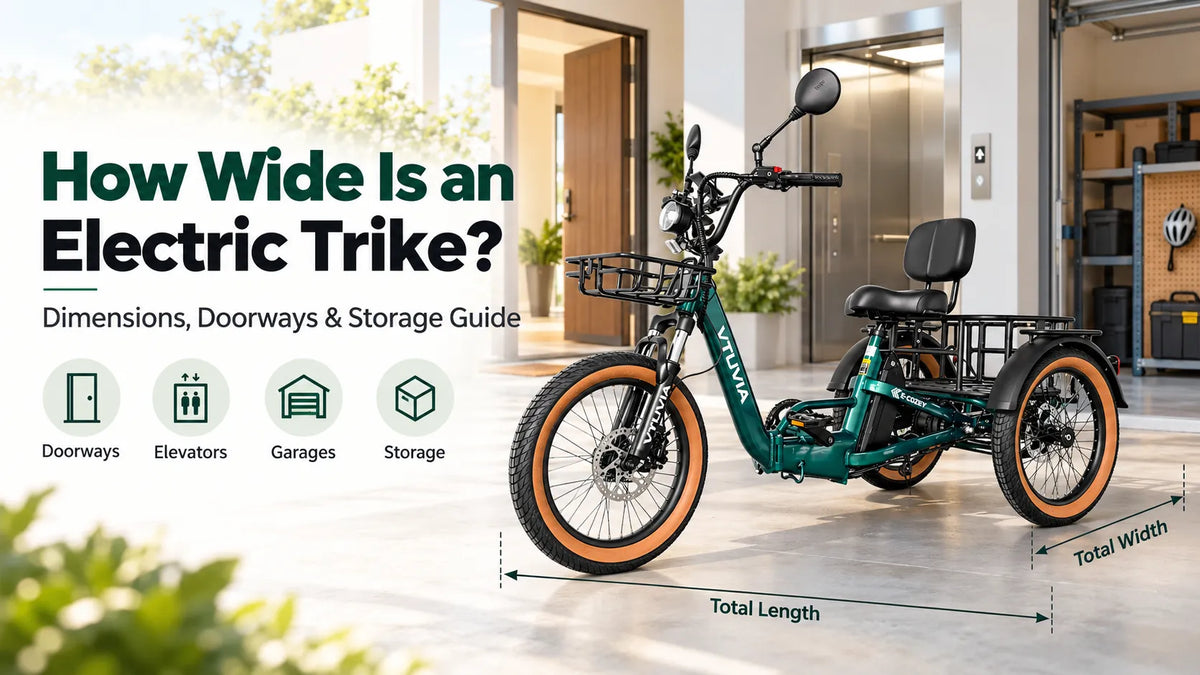
E-COZY folds to approximately 41.3" × 26.8" × 34.3".
Never buy a folding electric trike based on the word "folding" alone. Measure the space where you plan to store or transport it, then compare those measurements with the actual folded dimensions and total weight.
13. Compare Realistic Electric Trike Range, Not Just Maximum Range
Actual electric trike range can vary based on rider weight, cargo, hills, temperature, tire pressure, speed, assist level, throttle use, wind, and stop-and-go riding.
Instead of asking which electric trike has the longest advertised range, ask whether it has enough realistic range for the trips you actually plan to make.
E-COZY uses a 48V 15Ah / 720Wh battery, with published maximum range estimates of up to 70 miles with pedal assist and 40 miles using throttle only under appropriate conditions.
Actual range varies with riding conditions.
14. Check Electric Trike Rider Fit, Capacity, Service, and Support
Rider Fit
Check recommended rider-height ranges, seat adjustment, handlebar adjustment, step-through height, and whether you can comfortably reach the pedals, brakes, and controls.
Weight Capacity
Check the total rated load and remember that both rider and cargo count toward that limit.
Replacement Parts
An electric trike is something you'll own, ride, and maintain—not simply a product you unbox.
Warranty
Read what is actually covered and for how long rather than relying only on a warranty badge.
Service and Support
Find out what happens if you need maintenance, replacement components, setup assistance, or technical support.
Test Rides
If a test ride is available, take advantage of it. Specifications can tell you whether an electric trike might fit. A test ride can tell you how it actually feels.
15. Build Your Electric Trike Shortlist
Once you've worked through the major buying factors, identify the three to five things that matter most to you.
| If This Matters Most... | What to Look For |
|---|---|
| Getting on and off easily | Measured step-through height |
| Reducing physical effort | Pedal assist + throttle + useful torque |
| Sitting comfortably longer | Backrest + adjustable riding position |
| A more planted riding feel | Lower center of gravity + broad three-wheel platform |
| Smoother turning | Rear differential + thoughtful three-wheel geometry |
| Rough everyday pavement | Wider tires + suspension |
| Grocery and errand use | Practical cargo space + adequate capacity |
| Easier repositioning | Reverse assist + parking function |
| RV or limited storage | Actual folded dimensions + manageable weight |
| Natural pedal assistance | Torque sensor |
Your 5-Point Electric Trike Decision Checklist
Before making your final choice, write down your five highest priorities.
Access
How easy is it for you to get on and off?
Comfort
Does the complete riding position support how you want to sit?
Effort
How much pedaling do you want to do, and how should the motor help?
Control & Handling
How do the geometry, turning system, brakes, and parking features fit your riding environment?
Everyday Practicality
Will the cargo, storage, range, fit, and support work for the way you actually plan to use it?
Where Does E-COZY Fit When Choosing an Electric Trike?
Using this framework makes E-COZY easier to evaluate—not because it tries to offer every possible feature, but because its priorities are clear.
Comfort. Stability. Confident control. Everyday practicality.
E-COZY may be worth considering if your priorities include:
- 14.8-inch ultra-low step-through access
- Supportive seating with an adjustable backrest
- A relaxed riding position
- A lower, broad three-wheel platform
- Torque-sensing pedal assistance
- Throttle operation
- Rear differential
- Hydraulic disc braking
- 60 mm front suspension and 20 × 3.0-inch tires
- Reverse assist
- Everyday cargo space
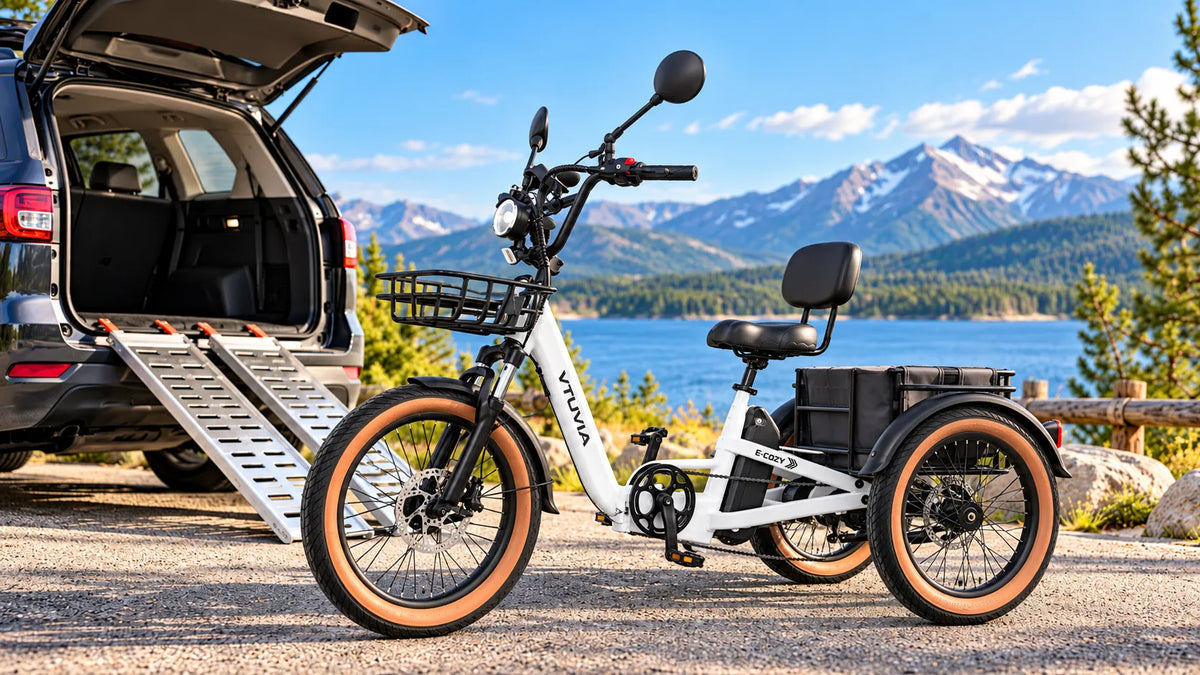
- Folding storage flexibility

VTUVIA E-COZY
A folding electric trike designed around easier access, supportive comfort, stable three-wheel handling, confident control, and practical everyday riding.
Choose VersionElectric Trike Buying FAQ
What should I look for when buying an electric trike?
Start with how you plan to use the trike. Then compare step-through height, riding position, back support, stability-related geometry, motor assistance, sensor type, brakes, turning design, suspension, tires, cargo capacity, range, storage dimensions, rider fit, and after-sales support.
How do I choose the right electric trike for my needs?
Write down your three to five highest priorities first. You may care most about easier mounting, reduced pedaling effort, back support, cargo capacity, or folding storage. Compare each trike against those priorities.
How do I choose the right size electric trike?
Check the manufacturer's recommended rider-height range, seat adjustment, handlebar adjustment, step-through height, overall dimensions, and weight capacity.
Is a torque sensor important when choosing an electric trike?
It can be useful for riders who prefer more proportional pedal assistance. A torque sensor responds to pedaling force, so assistance can change with rider effort.
Do I need a differential on an electric trike?
A differential allows the inside and outside rear wheels to rotate at different speeds during a turn, which can support more natural three-wheel cornering behavior.
Is a folding electric trike worth it?
It can be if storage or transportation flexibility matters to you. However, folding electric trikes are still relatively large and heavy, so compare the actual folded dimensions and weight.
Should I test ride an electric trike before buying?
If a test ride is available, it's one of the best ways to evaluate step-through access, riding position, steering, braking, motor response, fit, and low-speed handling.
Choose the Electric Trike for the Ride You Actually Want
The best electric trike for you isn't necessarily the one with the biggest motor, longest range, widest tires, or most accessories.
It's the one that removes the most friction from the rides you actually want to take.
Maybe that means getting on without lifting your leg as high. Maybe it's sitting with better support. Maybe it's carrying groceries without doing all of the extra work yourself. Or maybe it's having assistance available when the road rises.
Start with those needs.
Then let the specifications help you choose the electric trike that meets them.
For E-COZY, that philosophy comes back to one simple idea:
Keep Living. Keep Riding.
Share:
E-COZY vs. Traditional Trikes: What's the Difference?
Can You Ride an Electric Trike Without Pedaling?