
Traditional adult trikes have helped people enjoy three-wheel riding for decades. They are simple, familiar, and can be a practical choice for short rides.
But three wheels alone don't automatically make a trike easy to get on, comfortable to sit on, smooth through turns, easy to brake, or convenient to maneuver when you're carrying cargo.
That's where VTUVIA E-COZY takes the traditional trike concept further.
E-COZY keeps the broad three-wheel foundation, then adds electric assistance, supportive seating, a lower riding platform, a rear differential, hydraulic braking, suspension, reverse assist, and everyday cargo features.
If you're still learning how electric trikes work, our Complete Electric Trike Guide covers the basics before you compare different designs.
Table of Contents
- Quick Comparison
- 1. Three Wheels Don't Tell the Whole Stability Story
- 2. Getting On: Step-Through Height Matters
- 3. Seating: A Saddle vs. a Supported Riding Position
- 4. Pedaling: Who Does the Work?
- 5. How Electric Assistance Feels
- 6. Turning: Why the Rear Differential Matters
- 7. Rough Pavement and Ride Comfort
- 8. Braking and Parking
- 9. Moving Backward
- 10. Cargo and Everyday Use
- 11. Storage and Folding
- Which One Makes More Sense for You?
- Frequently Asked Questions
Quick Comparison: E-COZY vs. Traditional Adult Trikes
| Feature | Traditional Adult Trike | VTUVIA E-COZY |
|---|---|---|
| Three-wheel platform | Yes | Yes |
| Rider effort | Primarily rider-powered | Pedal assist + throttle |
| Step-through access | Varies by model | 14.8" ultra-low step-through |
| Back support | Often limited or optional | Supportive adjustable backrest |
| Riding position | Often bicycle-like | Relaxed, upright geometry |
| Motor assistance | Typically none | 750W motor |
| Pedal sensing | Not applicable | Torque sensor |
| Front suspension | Often rigid | 60 mm suspension fork |
| Tires | Often narrower | 20 × 3.0" |
| Rear differential | Not always | Yes |
| Braking | Varies | Hydraulic disc brakes, 180 mm rotors |
| Reverse assist | Typically no | Yes |
| Cargo | Often rear basket | Designed for everyday cargo use |
| Folding frame | Available on some models | Yes |
The biggest difference isn't any single row in the table.
It's how much work the rider—and the trike—are each expected to do.
1. Three Wheels Don't Tell the Whole Stability Story
The biggest thing traditional trikes and E-COZY have in common is also one of the main reasons riders consider three wheels in the first place.
Both provide three contact points with the ground, so they don't require the same balancing at a stop as a conventional two-wheel bicycle.
But wheel count alone doesn't determine how planted a trike feels.
Traditional Trikes
On a traditional adult trike, stability depends on factors such as overall width, wheel size, seat height, frame geometry, rider position, and weight distribution.
That means two trikes can both have three wheels yet feel very different underneath the rider.
E-COZY
E-COZY was designed around a relatively low riding platform and lower center of gravity.
Its front wheel and two widely spaced rear wheels create a broad triangular base underneath the rider.
The idea is straightforward:
Stay low. Build a broad base. Create a more planted riding experience.
Three wheels may help with balance at a stop, but E-COZY goes further by considering how low and broad the complete riding platform feels beneath the rider.
2. Getting On: Step-Through Height Matters More Than You Might Expect
A trike may feel stable once you're seated, but first you have to get onto it.
Traditional Trikes
Traditional adult trikes vary considerably in frame design. Some offer low-step frames, while others still require the rider to lift a leg higher to clear part of the frame.
That may not seem important during a quick showroom visit, but everyday riding means getting on and off repeatedly.
E-COZY
E-COZY uses a 14.8-inch ultra-low step-through frame, allowing the rider to step through the center rather than lifting a leg over a higher frame section.
Consider a normal trip: ride to the store, get off, shop, load your things, get back on, ride somewhere else, and get off again.
Easier access isn't just about the first time you get on the trike. It can make every stop during the day feel more approachable.
3. Seating: A Saddle Is Not the Same as a Supported Riding Position
A wide saddle is one of the most common comfort features on adult trikes.
But saddle size alone doesn't determine how comfortable the entire riding position feels.
Traditional Trikes
Many traditional adult trikes still use a bicycle-style seating layout with limited upper-body support.
That can work well for short rides and for riders who are comfortable supporting themselves in a conventional cycling posture. But for someone who prefers to sit more upright, limited back support can become more noticeable as the ride continues.
E-COZY
E-COZY combines a wide comfort saddle, supportive adjustable backrest, adjustable seating position, and adjustable stem.
The seat, backrest, handlebars, and pedals are designed to work together as one riding position rather than as isolated comfort features.
If you'd like to understand this part of trike design in more detail, read our guide to why a backrest matters on an electric trike.
Traditional trikes may give you a place to sit. E-COZY is designed to give the rider a more supported place to settle into.
4. Pedaling: Who Does the Work?
This is one of the biggest practical differences between a traditional trike and an electric trike.
Traditional Trikes
On a traditional pedal trike, every hill, extra grocery bag, headwind, and longer ride adds directly to the effort required from the rider.
If you're tired, the trike doesn't become lighter. If the basket is loaded, your legs still have to move the additional weight.
For riders who enjoy pedaling and mostly travel short, flat routes, that simplicity can be perfectly acceptable.
E-COZY
E-COZY uses a 750W motor with up to 85 Nm of torque, along with pedal assistance and throttle operation.
You can pedal when you want to, use assistance when you'd like the effort to feel lighter, or rely more heavily on the motor when you'd rather take it easy.
A hill, a heavier grocery load, or a day when you simply don't feel like pedaling as hard doesn't automatically have to mean staying home.
5. How Electric Assistance Feels Matters Too
Adding a motor solves part of the effort problem, but the way that motor responds also affects the riding experience.
Traditional Trikes
A conventional non-electric trike has a direct relationship between your effort and the speed of the trike: the work comes from you.
E-COZY
E-COZY uses a torque sensor that responds to the amount of force you're applying to the pedals.
Pedal gently, and assistance can come in gently. Apply more force, and the system can provide more support.
That proportional response is especially useful during low-speed starts, neighborhood riding, parking areas, and frequent stops during errands.
Electric assistance shouldn't only reduce effort. On a comfort-focused trike, it should also feel predictable and connected to what the rider is doing.
6. Turning: Why the Rear Differential Matters
Three-wheel vehicles don't turn like two-wheel bicycles.
When a trike enters a corner, the outside rear wheel travels farther than the inside rear wheel.
Traditional Trikes
On simpler trike drivetrain designs, the rear wheels may not manage that difference as independently, which can make low-speed cornering feel heavier or less natural depending on the design.
E-COZY
E-COZY uses a rear differential, allowing the two rear wheels to rotate at different speeds while turning.
That means the outside rear wheel can travel farther while the inside wheel travels a shorter path.
The result is smoother, more natural cornering behavior.
A differential doesn't mean a trike should be cornered aggressively. Riders should still slow appropriately before turns and take time to learn three-wheel handling.
Three wheels create the platform. The differential helps those rear wheels work together more naturally when the trike changes direction.
7. Rough Pavement: Simplicity vs. Added Ride Comfort
Traditional Trikes
Traditional adult trikes are often mechanically simple, and that simplicity can be an advantage. But many use rigid forks and narrower tires, which can allow more road vibration to reach the rider.
E-COZY
E-COZY uses a 60 mm front suspension fork and 20 × 3.0-inch tires.
The suspension helps absorb impacts at the front wheel, while the wider tires add another layer of cushioning between the road and the rider.
You don't need to ride mountain-bike trails to notice the difference. Neighborhood streets, bike paths, parking lots, pavement joints, and rough patches are enough.
Traditional simplicity may be enough on smooth, short routes. E-COZY adds components specifically intended to make imperfect everyday pavement feel less disruptive.
8. Braking and Parking: More Weight Requires More Thought
Traditional Trikes
Braking systems vary widely across traditional adult trikes. For lighter, lower-speed pedal trikes, simpler systems may be sufficient for their intended use.
E-COZY
An electric trike carries more equipment: a motor, battery, stronger frame, cargo capacity, and potentially a heavier overall load.
E-COZY uses hydraulic disc brakes with 180 mm rotors to provide controlled braking for its three-wheel platform.
It also includes a parking function for everyday situations such as getting on or off, loading cargo, or leaving the trike stationary.
E-COZY isn't only designed around moving the trike. It also considers slowing it, stopping it, and keeping it stationary when the ride pauses.
9. Moving Backward: A Small Difference That Can Feel Very Big
This is one of those features that doesn't sound important until the first time you need it.
Traditional Trikes
A lightweight traditional trike may be easy enough to reposition manually when it's empty. Depending on the rider and the trike, you may simply push it backward or use your feet to move it.
E-COZY
An electric trike is naturally heavier because of the motor, battery, frame, and additional equipment. Add groceries or other cargo, and manually repositioning the trike can become less convenient.
That's why E-COZY includes reverse assist.
It's designed for ordinary situations: backing away from a garage wall, leaving a tighter parking space, or repositioning the trike before turning.
Reverse assist isn't about riding backward for long distances. It's about reducing the effort required during the awkward little moments of everyday trike ownership.
10. Cargo: The Basket Isn't the Whole Story
Cargo capacity has long been one of the strengths of adult tricycles.
Traditional Trikes
Many traditional trikes offer a rear basket that can be useful for groceries, personal items, or supplies.
But every item added to that basket also adds weight that the rider has to move.
E-COZY
E-COZY keeps the practical cargo concept but pairs it with electric assistance.
That can make trips involving groceries, farmers market purchases, picnic supplies, personal belongings, small packages, or pet supplies feel more manageable.
The basket itself isn't necessarily the innovation. The bigger difference is being able to carry useful cargo without asking your legs to handle all of the additional work.
11. Storage: E-COZY Adds a Folding Frame
One challenge applies to almost every adult trike:
Three wheels take up space.
Traditional Trikes
Many conventional trikes use fixed frames, although folding models do exist. A full-size adult trike generally requires more storage planning than a standard bicycle.
E-COZY
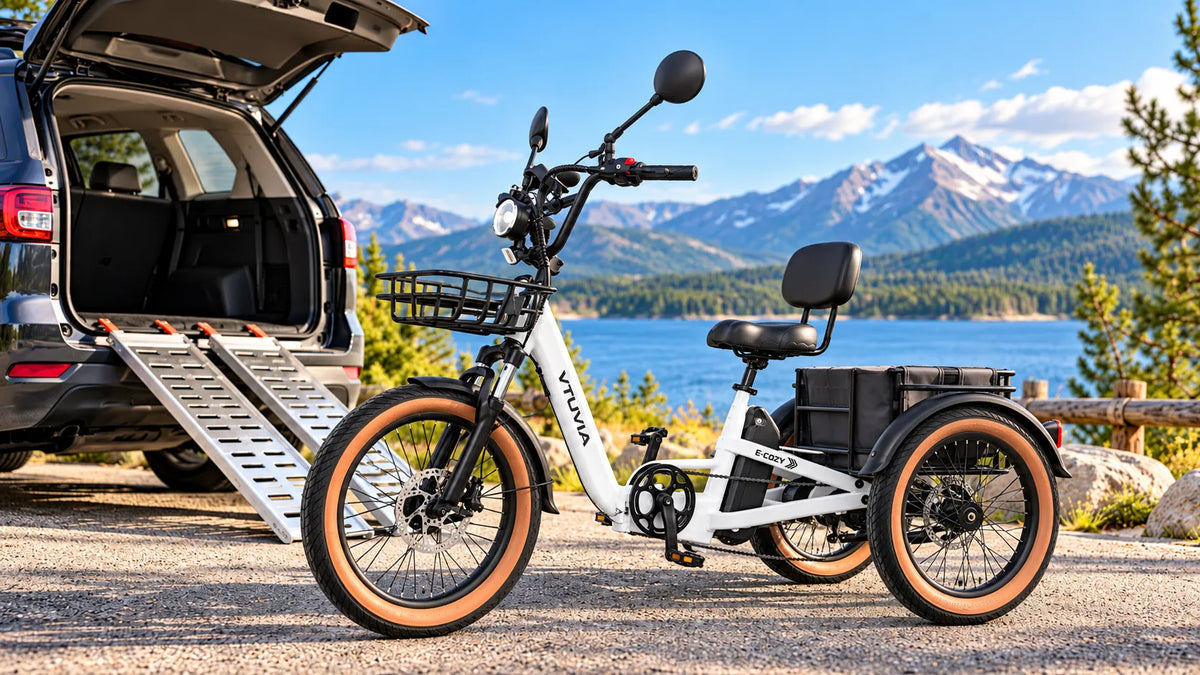
E-COZY uses a folding frame, giving owners another option when thinking about garages, RVs, transportation, or limited storage flexibility.
It's important to keep expectations realistic: a folded electric trike is still a substantial three-wheel vehicle.
Folding doesn't make the trike tiny. It simply gives you more flexibility than a completely fixed frame when storage or transportation matters.

Meet VTUVIA E-COZY
A comfort-focused electric trike designed around easier access, supportive seating, stable three-wheel handling, electric assistance, and everyday practicality.
Starting at $2,099 Explore E-COZYE-COZY vs. Traditional Trike: Which One Makes More Sense for You?
This comparison isn't about declaring that every traditional trike is bad or that every rider needs an electric model.
It's about understanding what each type of trike asks from the rider.
A Traditional Trike May Make More Sense If...
- You prefer mechanical simplicity.
- You enjoy pedaling without electric assistance.
- Your rides are mostly short and flat.
- You don't need throttle assistance.
- You don't need reverse assist.
- You are comfortable with a more traditional cycling position.
- You prefer fewer electrical components.
E-COZY May Make More Sense If...
- You want electric assistance to reduce riding effort.
- An ultra-low step-through matters to you.
- You prefer supportive seating with a backrest.
- You value a lower, broader three-wheel platform.
- You want smoother torque-sensing assistance.
- You prefer suspension and wider tires.
- You want a rear differential for three-wheel cornering.
- You value hydraulic braking and parking functionality.
- You want reverse assist.
- You regularly carry groceries or everyday cargo.
- You want a folding frame for additional storage flexibility.
Neither choice is defined simply by age.
The better question is:
How much do you want the trike to adapt to you, rather than asking you to adapt to the trike?
The Bigger Difference: From "Able to Ride" to "Wanting to Ride"
Traditional trikes solve an important problem: they give riders a three-wheel alternative to a conventional bicycle.
But once you start thinking about how a trike will be used every day, more questions appear.
Is it easy to get on?
Does your back feel supported?
How much effort does a hill require?
What happens when the basket is full?
How does the trike behave through a turn?
Can you comfortably stop and park it?
What happens when you need to back out of a tight space?
E-COZY was designed around those next questions.
The goal isn't simply to make a traditional trike electric.
It's to create a three-wheel riding experience that feels more comfortable, more manageable, and more practical for everyday life.
Frequently Asked Questions
Is an electric trike easier to ride than a traditional trike?
An electric trike can reduce the physical effort required for pedaling, hills, and carrying cargo because the motor assists. Features such as throttle operation, lower step-through access, supportive seating, and reverse assist can also make everyday use easier. However, three-wheel handling is different from riding a bicycle, so new riders should take time to become familiar with turning and braking.
Is an electric trike more stable than a regular tricycle?
Not automatically. Three wheels alone don't determine stability. Overall width, center of gravity, rider position, speed, weight distribution, and cornering behavior all matter. E-COZY combines a relatively low riding platform with a broad three-wheel base and rear differential to create a more planted riding experience.
What is the advantage of a differential on an electric trike?
During a turn, the outside rear wheel travels farther than the inside rear wheel. A rear differential allows the two rear wheels to rotate at different speeds, helping the trike follow the turn more naturally. Riders should still slow appropriately before corners.
Can E-COZY ride without pedaling?
E-COZY includes throttle operation in addition to pedal assistance, so riders don't have to rely entirely on pedaling for propulsion. How and where throttle operation can be used may depend on local riding regulations.
Is a traditional trike or an electric trike better for seniors?
It depends on the rider. A traditional trike may suit someone who prefers mechanical simplicity and enjoys pedaling on short, flat routes. An electric trike may be more appealing to riders who value easier step-through access, back support, reduced pedaling effort, smoother assistance, cargo carrying, reverse assist, and additional everyday convenience.
A Traditional Idea, Reconsidered for Everyday Riding
The basic adult tricycle is built around a useful idea:
Three wheels can give riders another way to ride.
E-COZY doesn't replace that idea.
It builds on it.
A 14.8-inch ultra-low step-through makes access easier. A supportive seat and backrest create a more relaxed riding position. A low riding platform and broad three-wheel base help create a planted feel.
A rear differential changes how the rear wheels work through turns. A torque sensor, pedal assist, and throttle give riders more choices about how much effort they want to contribute.
Suspension and wider tires help soften everyday pavement, while hydraulic brakes, parking functionality, and reverse assist give the rider more control over a larger three-wheel vehicle.
And cargo capacity plus a folding frame make the trike easier to integrate into everyday routines.
That's what separates E-COZY from a basic traditional trike.
Not three wheels for the sake of three wheels.
But a three-wheel riding experience designed around the person sitting in the middle of them.
Comfort. Stability. Everyday freedom.
Keep Living. Keep Riding.

Share:
Meet E-COZY: Built for Comfort, Stability, and Everyday Freedom
How to Choose the Right Electric Trike: A Practical Buyer's Guide