

Electric trikes and mobility scooters can both make everyday travel easier, but they are designed for very different ways of getting around.
A mobility scooter prioritizes simple, low-effort transportation for shorter trips, while an electric trike combines transportation with riding, outdoor activity, cargo capacity, and a wider everyday travel radius.
Although they may look similar at first glance, they are built for different purposes, different riding experiences, and different everyday lifestyles.
Understanding those differences can help you choose the option that best matches how you want to move through your day.
The better choice is not necessarily the one with the most power, longest range, or lowest price.
It is the one that fits your daily routine, physical abilities, storage situation, and the lifestyle you want to maintain.
If you are still learning how electric trikes work, start with our Complete Electric Trike Guide for a broader introduction to three-wheel e-bikes, comfort, stability, safety, and buying considerations.
Table of Contents
- The Quick Answer
- Built for Different Purposes
- How Do You Want to Get Around?
- How Far Do You Usually Travel?
- What Do You Need to Carry?
- Transportation or an Active Lifestyle?
- Portability and Public Transportation
- Stability, Safety, and Riding Confidence
- Electric Trike vs. Mobility Scooter Comparison
- Which One Should You Choose?
- When Does E-COZY Make More Sense?
- Frequently Asked Questions
Electric Trike vs. Mobility Scooter: The Quick Answer
A mobility scooter is usually the better fit for someone who wants low-effort transportation for short trips, sidewalks, stores, appointments, and environments where compactness is important.
An electric trike is usually the better fit for someone who can safely pedal and steer, wants to continue riding, travels several miles at a time, carries groceries or other cargo, and values outdoor recreation as well as transportation.
The most important question is not which product is universally better.
The real question is whether you need mobility assistance or a more comfortable way to continue an active riding lifestyle.
They Are Built for Different Purposes
Electric trikes and mobility scooters may both use three or more wheels, electric power, a seat, and handlebar-style controls.
However, their core purposes are different.
What Is an Electric Trike Designed For?
An electric trike is designed around the experience of riding.
It combines pedal power with electric assistance, allowing the rider to remain involved in the movement of the vehicle.
An electric trike is commonly used for:
- Neighborhood rides
- Local commuting
- Grocery shopping
- Farmers market trips
- Park and bike-path riding
- Visiting friends and family
- Outdoor recreation
- Carrying everyday cargo
What Is a Mobility Scooter Designed For?
A mobility scooter is designed primarily to reduce the physical effort required to travel.
The rider sits, steers, and uses a throttle-style control without pedaling.
A mobility scooter is commonly used for:
- Short sidewalk trips
- Shopping centers
- Medical appointments
- Pharmacy visits
- Indoor stores
- Large campuses or facilities
- Reducing the need to walk
- Connecting with public transportation
One is designed to help you continue riding.
The other is designed to help you travel with as little physical effort as possible.
How Do You Want to Get Around?
Your normal daily routine is one of the strongest indicators of which option will work better for you.
Think about where you go most often, what surfaces you travel on, whether you spend more time indoors or outdoors, and whether the trip itself is something you want to enjoy.
| Everyday Situation | Electric Trike | Mobility Scooter |
|---|---|---|
| Riding through a neighborhood | Very well suited | Well suited for shorter distances |
| Visiting a nearby pharmacy | Well suited | Very well suited |
| Shopping inside a large store | Usually less practical | Very well suited |
| Riding on a bike path | Very well suited where permitted | May not be permitted or practical |
| Going to a farmers market | Very well suited | Well suited for smaller purchases |
| Traveling several miles across town | Very well suited | Depends on model, terrain, and battery |
| Taking the vehicle onto a bus | Usually difficult | Some compact models may be accepted |
| Carrying a full grocery load | Very well suited with cargo baskets | Limited by basket size and capacity |
| Enjoying a weekend outdoor ride | Very well suited | Designed more for transportation than recreation |
Choose Based on Your Routine, Not Just the Product Category
A person who mainly travels from an apartment to a nearby bus stop has very different needs from someone who rides three or four miles to a farmers market and returns with groceries.
The first person may benefit more from a compact mobility scooter.
The second may find an electric trike more practical because it offers a larger travel radius, greater cargo capacity, and a more recreational outdoor experience.
How Far Do You Usually Travel?
Travel distance is another major factor.
Instead of focusing only on advertised battery range, think about your real everyday travel radius.

Mobility Scooter Travel
A mobility scooter often works best when destinations are close together and the route is built around sidewalks, ramps, stores, transit stops, and paved public spaces.
Typical uses may include:
- Traveling around a shopping center
- Reaching a nearby pharmacy
- Moving through a retirement community
- Getting from a parking area to an appointment
- Connecting a short trip with a bus or train
For these users, compact size and simple operation may matter more than cargo capacity or long-distance riding comfort.
Electric Trike Travel
An electric trike is better suited to trips where the rider expects to travel several miles, spend more time outdoors, or combine multiple errands into one ride.
- Riding across a neighborhood
- Traveling to a local grocery store
- Visiting a park or waterfront path
- Going to a farmers market
- Meeting friends for coffee
- Replacing selected short car trips
For these users, riding comfort, stability, battery capacity, cargo space, and the ability to cover a larger area become more important.
A mobility scooter can make a nearby destination more accessible.
An electric trike can expand the number of destinations you consider nearby.
If you're interested in groceries, neighborhood riding, parks, local trips, and other everyday uses, browse our Cycling Life articles.
How Much Do You Need to Carry?
Storage is one of the most practical differences between an electric trike and a compact mobility scooter.
Many lightweight mobility scooters are designed to keep the vehicle as small, simple, and portable as possible.
Because of that, built-in cargo capacity may be relatively limited compared with a full-size electric trike.

A mobility scooter can work well when the rider only needs to bring a phone, wallet, medication, water bottle, or a few personal items.
But larger shopping trips can change the equation.
| What You Need to Carry | Electric Trike | Compact Mobility Scooter |
|---|---|---|
| Phone, wallet, medication | Easy to store in a basket or bag | Usually manageable |
| Water bottle and daily essentials | Easy to carry | Usually manageable |
| Several grocery bags | Well suited with cargo storage | Depends on available storage |
| Farmers market purchases | Well suited | More limited on compact models |
| Picnic supplies or a small cooler | Often practical | May be less practical |
| Pet supplies or a secured pet carrier | Possible with suitable cargo equipment | Depends on scooter design and accessories |
If your routine includes shopping, carrying supplies, visiting markets, or combining multiple errands into one trip, cargo capacity may become one of the strongest reasons to consider an electric trike.
Do You Want Transportation or an Active Lifestyle?
This may be the most important difference in the entire comparison.
A mobility scooter helps reduce the effort required to reach a destination.
An electric trike helps the rider remain physically and mentally involved in the journey.

A Mobility Scooter Prioritizes Low-Effort Transportation
A mobility scooter may be the right choice when the main goal is to avoid walking, conserve energy, and move comfortably between nearby destinations.
The ride itself is primarily functional.
An Electric Trike Combines Transportation With Riding
An electric trike still requires the rider to steer, understand turning behavior, and usually participate through pedaling.
Electric assistance reduces the effort required, but the experience still feels like riding.
This makes an electric trike suitable for people who want transportation but do not want to give up outdoor activity, neighborhood exploration, recreational riding, or the sense of freedom associated with cycling.
You do not simply arrive. You remain part of the ride.
Portability and Public Transportation
Mobility scooters generally have an advantage when compact transportation and indoor accessibility are the main priorities.
Some travel mobility scooters can be folded or separated into smaller pieces for storage in a vehicle.
Certain compact models may also be accepted on buses, trains, paratransit services, and other forms of public transportation.
Acceptance depends on vehicle dimensions and weight, available space, securement requirements, battery type, and the rules of the local transportation provider.
Riders should always confirm requirements directly with the transit operator.
Electric trikes are larger and wider.
Even folding electric trikes may still be difficult to lift, fit into a standard vehicle, or bring onto public transportation.
A mobility scooter may work better if your routine regularly involves buses, trains, elevators, indoor stores, a small apartment, or frequent car transportation.
An electric trike may work better if you can ride directly from home to most destinations and have enough storage space for a larger vehicle.
Stability, Safety, and Riding Confidence
Both mobility scooters and electric trikes can offer more low-speed stability than a traditional two-wheel bicycle because the rider does not need to balance the vehicle at a complete stop.
However, neither vehicle is impossible to tip.
Stability depends on product design, riding surface, speed, turning technique, weight distribution, and rider behavior.
Mobility Scooter Handling
Mobility scooters are generally operated at lower speeds and are designed for controlled movement through sidewalks, stores, and other pedestrian-oriented environments.
Their simple controls and low-effort operation may feel more approachable to someone who does not want to pedal or manage a bicycle-style drivetrain.
Electric Trike Handling
An electric trike feels different from both a bicycle and a mobility scooter.
The rider does not lean into a turn in the same way as on a two-wheel bike.
Turns should be approached at a controlled speed, with smooth steering and awareness of the trike's width.
Features that can support easier control include:
- A low step-through frame
- A lower center of gravity
- A supportive riding position
- A wide and balanced rear stance
- Predictable power delivery
- Effective braking
- A rear differential
A well-designed electric trike can feel stable and predictable, but new riders should still practice starting, stopping, turning, and judging rear-wheel width in a quiet open area.
For more on braking, stability, cornering, visibility, and first-time riding, explore our Electric Trike Safety guides.
Electric Trike vs. Mobility Scooter Comparison
| Decision Factor | Electric Trike | Mobility Scooter |
|---|---|---|
| Primary purpose | Riding, transportation, recreation, errands | Mobility assistance and low-effort transportation |
| Physical participation | Usually includes pedaling and active steering | No pedaling required |
| Typical trip type | Neighborhood trips and several-mile rides | Short local, indoor, or sidewalk trips |
| Cargo capacity | Often supports larger front or rear baskets | Varies, often smaller on travel models |
| Public transportation | Usually difficult because of size and width | Some compact models may be easier to transport |
| Indoor use | Usually not suitable | Often suitable where allowed |
| Bike paths | Often suitable where local rules permit | Rules and suitability vary by location |
| Outdoor recreation | A major use case | Possible, but usually not the primary purpose |
| Exercise | Can provide gentle physical activity | Designed to minimize physical effort |
| Storage needs | Requires more floor space | Compact travel models may require less space |
| Best suited for | People who still want to ride and remain active | People whose priority is mobility assistance |
Which One Should You Choose?
The right choice depends on your physical ability, travel distance, storage situation, preferred environments, and what you want the vehicle to help you do.

A Mobility Scooter May Be the Better Choice If:
- Walking even short distances has become difficult
- You do not want or are not able to pedal
- You primarily travel on sidewalks or inside stores
- Most trips are short and destination-focused
- You regularly use buses, trains, or paratransit
- You need a compact vehicle for car transportation
- Your priority is conserving energy
- You need mobility assistance more than recreational riding
An Electric Trike May Be the Better Choice If:
- You can safely pedal and want to continue riding
- You enjoy spending time outdoors
- You want transportation plus gentle physical activity
- You regularly travel several miles
- You ride through neighborhoods, parks, or bike paths
- You need to carry groceries or everyday cargo
- You want to replace selected short car trips
- You value comfort, stability, and everyday independence
Choose a mobility scooter when your main need is assistance getting to a destination.
Choose an electric trike when you still want both the destination and the experience of riding there.
If you've decided a three-wheel e-bike better fits your lifestyle but aren't sure which model or features to choose, browse our Electric Trike Buying Guides .
When Does E-COZY Make More Sense?
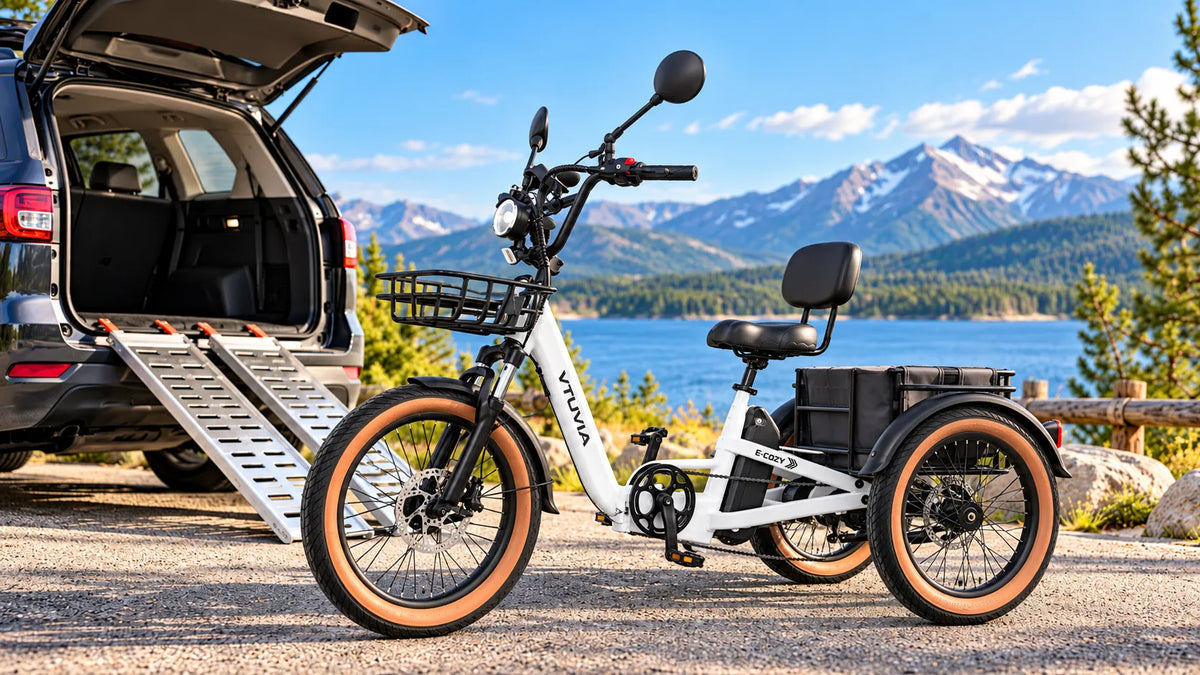
VTUVIA E-COZY is designed for people who can safely pedal and steer but want more comfort, stability, cargo capacity, and easier everyday control than a traditional two-wheel bicycle may provide.

Bring More of Everyday Life With You
E-COZY includes practical cargo space for groceries, market purchases, daily supplies, and other essentials.
It is intended for riders whose everyday trips include more than simply reaching the nearest destination.
Built for More Than Point A to Point B
A compact mobility scooter can be an excellent tool for short, low-effort transportation.
E-COZY is for riders who still want to participate in the journey, travel several miles, carry everyday cargo, and spend time outdoors.
E-COZY May Be Right for You If:
- You still want to pedal, steer, and enjoy riding
- You want more low-speed stability than a traditional two-wheel bike
- You regularly carry groceries or everyday supplies
- You want to complete several-mile trips without using a car
- You prefer a relaxed, supported riding position
- You want a trike designed around comfort, safety, and stability
E-COZY is not a medical mobility device.
Riders who cannot pedal or operate a trike safely, mainly travel indoors, or require medically appropriate mobility assistance may be better served by a mobility scooter or another mobility solution appropriate to their needs.
Comfort is one of the biggest differences riders notice when switching to a three-wheel bike. Explore our Electric Trike Comfort articles for more on seating, back support, suspension, and riding position.
VTUVIA E-COZY Electric Trike
For riders who still want to ride, explore, carry cargo, and stay part of the journey.

Already Decided an Electric Trike Fits You Better?
The next step is comparing comfort, fit, range, braking, cargo capacity, and everyday usability across different electric trikes.
Compare Electric Trikes →Frequently Asked Questions
Is an electric trike better than a mobility scooter?
Neither option is better for everyone. An electric trike is generally more suitable for someone who can safely pedal and steer, wants outdoor recreation, carries cargo, and travels several miles. A mobility scooter is generally more suitable for someone who needs low-effort mobility assistance for shorter trips, sidewalks, stores, and appointments.
Can an electric trike replace a mobility scooter?
An electric trike should not automatically be treated as a replacement for a mobility scooter. A trike requires active steering, turning awareness, and usually some level of pedaling ability. Someone who cannot operate a trike safely or needs a medically appropriate mobility device may be better served by a mobility scooter or another appropriate mobility solution.
Which is easier to use, an electric trike or a mobility scooter?
A mobility scooter may be easier for someone who wants simple throttle-controlled transportation without pedaling. An electric trike requires more active participation and a short learning period, particularly when turning, stopping, and judging the width of the rear wheels.
Which is better for grocery shopping?
An electric trike is often practical for larger grocery trips because many models provide substantial front or rear cargo capacity. Mobility scooter storage varies by model, with compact travel scooters generally offering less cargo room.
Can you take a mobility scooter on a bus?
Some mobility scooters may be accepted on buses, trains, and paratransit services, but size, weight, securement, battery, and accessibility requirements vary. Always check directly with the local transportation provider before traveling.
Can you take an electric trike on public transportation?
Electric trikes are generally more difficult to bring onto buses or trains because they are wider, heavier, and larger than many mobility scooters. Local rules vary, so riders should confirm requirements with the transportation provider.
Are electric trikes stable?
Electric trikes do not require the rider to balance at a complete stop, but they still need to be operated correctly. Stability depends on frame design, center of gravity, rear width, speed, road surface, cargo distribution, and turning technique.
Do you have to pedal an electric trike?
This depends on the model and local regulations. Many electric trikes provide pedal assistance, while some also include a throttle. Even when a throttle is available, the vehicle still requires active steering and safe control by the rider.
Final Thoughts: Choose the Way You Want to Move
A mobility scooter and an electric trike can both support greater independence, but they are built around different versions of everyday freedom.
A lightweight mobility scooter is designed for convenient, low-effort travel over shorter distances.
Its compact size may make it easier to navigate sidewalks, reach nearby destinations, enter suitable indoor environments, and connect with public transportation.
An electric trike is designed for riders who want more than a compact way to reach the next destination.
It can provide room for groceries and everyday cargo, support longer neighborhood and community trips, and allow the rider to remain involved through pedaling and steering.
The choice becomes clearer when you ask what you actually want from the vehicle.
If you need the smallest and simplest way to complete short local trips with minimal physical effort, a mobility scooter may be the better fit.
If you still want to ride, carry what you need, travel several miles, and enjoy more of the journey, an electric trike may better match the lifestyle you want to maintain.
Keep Living. Keep Riding.
E-COZY was built for riders who still want to be part of the ride, with three-wheel stability, a relaxed riding position, practical cargo capacity, and electric assistance for everyday trips.

Share:
ComfortFit™ Ergonomic System: Why Electric Trike Comfort Starts with Better Design
Are Electric Trikes Safe? What Every First-Time Rider Should Know